1-Pentanol → 1-Butanol
Reaction equation

[CH2:1]([OH:6])[CH2:2][CH2:3][CH2:4]C>C(O)CC>[CH:1](=[O:6])[CH2:2][CH2:3][CH3:4].[CH2:1]([OH:6])[CH2:2][CH2:3][CH3:4]Participants
Reactant 1

Product 2
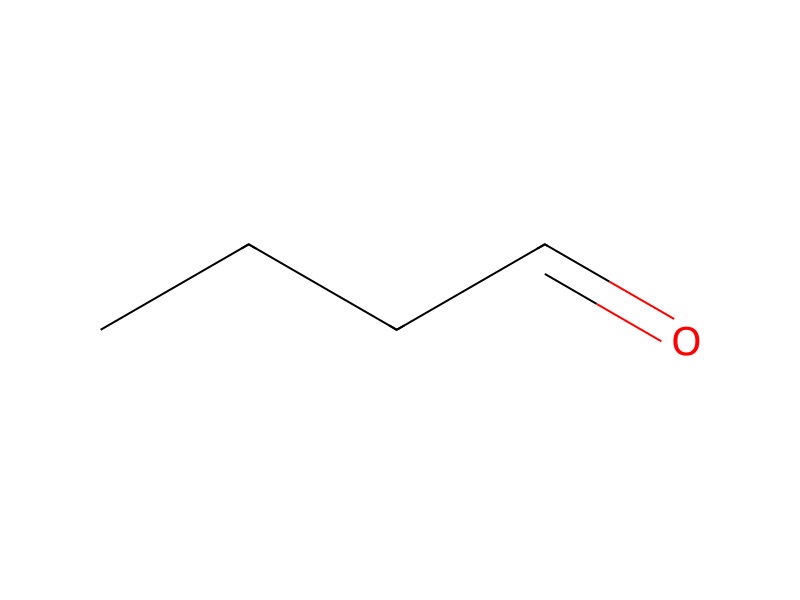

Reagents, catalysts & solvents 1

Procedure
In all representation examples of JP 6 2108-832, the hydrogenation is carried out using hydrogen at atmospheric pressure. Cycloaliphatic carboxylic acids such as cyclohexanecarboxylic acid are predominantly converted into cyclohexanecarbaldehyde with 98-99% selectivity using undoped zirconium dioxide at 300-350° C. and atmospheric pressure (Examples 1-7). The aliphatic carboxylic acid pivalic acid yields pivalaldehyde with 100% selectivity (Example 8). However, aliphatic carboxylic acids or their esters having two alpha hydrogen atoms are converted into the corresponding alcohols or mixtures of alcohols and aldehydes in moderate yields and selectivities using chromium-doped zirconium dioxide at 320° C. and atmospheric pressure. For instance, n-heptanoic acid and methyl n-heptanoate produce n-heptanol in a yield of 62% or 33.9%, respectively (Examples 9 and 10), propionic acid (Example 14) and valeric acid (Example 16) produce n-propanol in a yield of 34.6% and only traces of n-pentanol (37.1% n-valeraldehyde yield). Buteric acid (Example 15) produces a mixture of n-butyraldehyde (15.8% yield) and n-butanol (30% yield).
Workup
- customButeric acid (Example 15) produces
Sources & evidence
- ORD record
- ord-8d20fe49eb544e2bb2ad0e42a6202467
- Source dataset
- uspto-grants-2000_10
- Patent number
- US06140545
Reaction notes
Loading…