Cyanuric chloride → 2,4-Dichloro-6-cyclopropyl-1,3,5-triazine
Reaction equation

[CH:1]1(N)[CH2:3][CH2:2]1.C(N(CC)CC)C.[N:12]1[C:19]([Cl:20])=[N:18][C:16](Cl)=[N:15][C:13]=1[Cl:14]>CC(C)=O>[CH:1]1([C:16]2[N:18]=[C:19]([Cl:20])[N:12]=[C:13]([Cl:14])[N:15]=2)[CH2:2][CH2:3]1Participants
5
Reactant 3
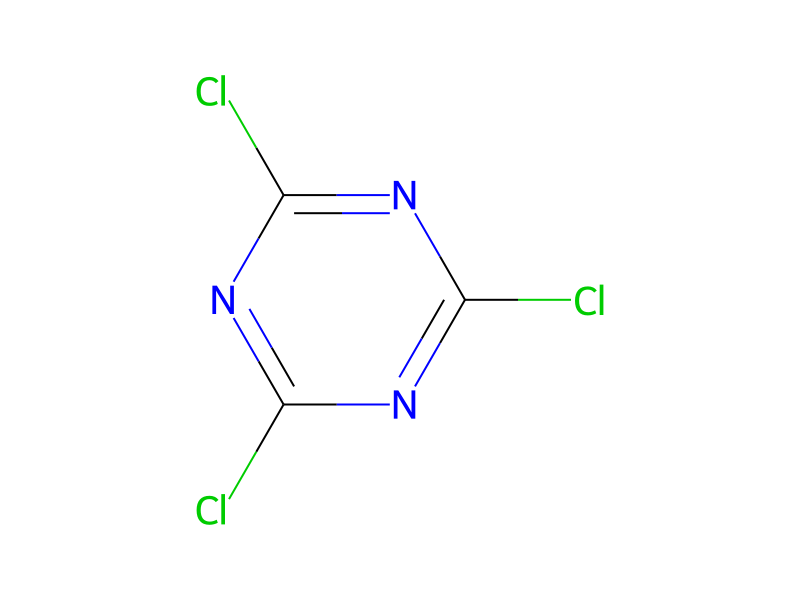


Product 1

Reagents, catalysts & solvents 1

Procedure
A mixture of 28.5 g of cyclopropylamine and 50.5 g of triethylamine was added drop-by-drop to a stirred solution of 92.3 g of cyanuric chloride in 1.5 liters of dry acetone at room temperature. Then the acetone was evaporated and the residue was treated with a 1:1 v:v mixture of ice water and ether. The ether phase was separated and dried (MgSO4), and the ether was evaporated to give 2-cyclopropyl-4,6-dichloro-1,3,5-triazine (9A), as a white solid, m.p.: 106°-107° C.
Workup
- customThen the acetone was evaporated
- additionthe residue was treated with a 1:1 v
- additionv mixture of ice water and ether
- customThe ether phase was separated
- dry with materialdried (MgSO4)
- customthe ether was evaporated
Sources & evidence
- ORD record
- ord-58f042bb399b43759676d6b90c00d0dd
- Source dataset
- uspto-grants-1985_07
- Patent number
- US04528027
Reaction notes
Loading…