Hydrochloric Acid → L-Tartaric acid
Reaction equation

[C:1]([C@@H:4]([C@H:6]([C:8]([O-:10])=[O:9])[OH:7])[OH:5])([O-:3])=[O:2].[Ca+2].Cl>O>[C:8]([OH:10])(=[O:9])[C@@H:6]([C@H:4]([C:1]([OH:3])=[O:2])[OH:5])[OH:7]Participants
Reactant 2


Product 1
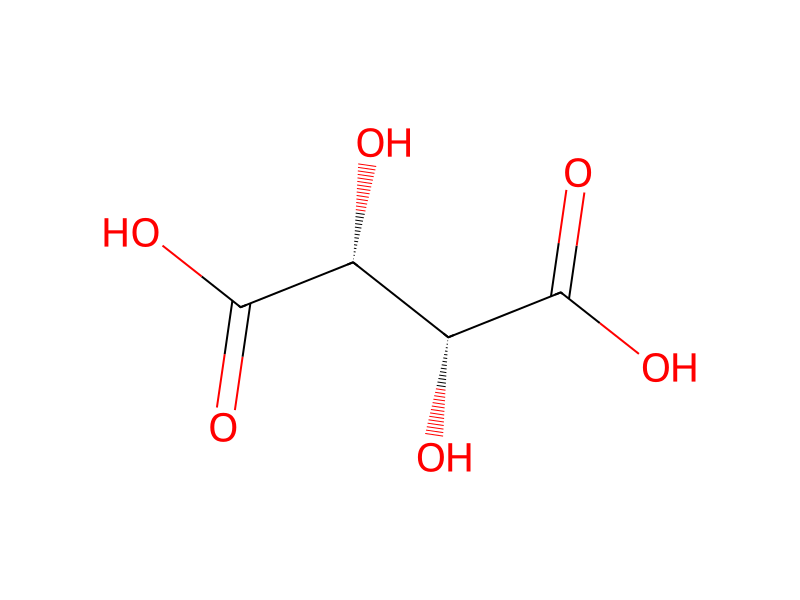
Reagents, catalysts & solvents 1

Procedure
The culture broth obtained similarly to Example 1 was centrifuged to separate the cells therefrom. The cells were suspended in 200 ml of a 0.05 mol/l phosphate buffer solution adjusted in advance to pH 7.0 and the suspension was again centrifuged to clean the cells. This cleaning was repeated to give a total of three cycles. A 0.5 g portion of the cleaned cells was added to a 100 ml of solution containing 1.0 g of dihydrated calcium hydrogen cis-epoxysuccinate and 0.3 g of calcium carbonate as the substrate. The resultant mixture was adjusted to pH 8.0 and shaken at 35° C for 4 hours. The substrate was wholly used up and the reaction mixture was found to have produced calcium L(+)-tartrate. The amount of calcium L(+)-tartrate thus produced was 1.09 g. The yield was 98%. The resultant reaction mixture was incorporated with both 1.0 g of dihydrated calcium hydrogen cis-epoxysuccinate and 0.3 g of calcium carbonate thereto and was shaken at 35° C for 4 hours. The substrate present in the reaction mixture was wholly used up and converted into calcium L(+)-tartrate. The amount of the product was 2.18 g and the yield thereof based on the charged substrate was 98%. In this manner, 1.0 g portions of dihydrated calcium hydrogen cis-epoxysuccinate and 0.3 portions of calcium carbonate were added one each at a time to respective totals of 20.0 g and 6.0 g. Finally, the substrate thus successively added was wholly used up to produce the precipitate of calcium L(+)-tartrate. The amount of the product thus produced was 22.0 g and the yield thereof was 99 percent. The calcium L(+)-tartrate was suspended in about 200 ml of water. While the suspension was kept under agitation, 1N hydrochloric acid was added until the precipitate of calcium L(+)-tartrate was dissolved. The resultant liquid was centrifuged to remove the microbic cells therefrom. The remaining solution was passed through a column measuring 3 × 80 cm and packed with Amberlite IR 120 (H+ type cation-exchange resin) and the adsorbate was eluted with water. By concentrating to dryness the eluate under reduced pressure, there was obtained 15.7 g of L(+)-tartaric acid in the form of crystals. The yield was 89 percent and the optical purity was 100 percent.
Workup
- customThe amount of the product thus produced
- customthe yield
- dissolutionwas dissolved
- customto remove the microbic cells
- washthe adsorbate was eluted with water
- concentrationBy concentrating to dryness the eluate under reduced pressure
Sources & evidence
- ORD record
- ord-d54bd15f8fa54da19bfd4f325f4ee5be
- Source dataset
- uspto-grants-1978_05
- Patent number
- US04092220
Reaction notes
Loading…