Toluene → Bis(eta-cyclopentadienyl) iron
Reaction equation

[Fe:1].[CH-:2]1[CH:6]=[CH:5][CH:4]=[CH:3]1.[CH-:7]1[CH:11]=[CH:10][CH:9]=[CH:8]1.[Fe+2].[C:13]1([CH3:19])[CH:18]=[CH:17][CH:16]=[CH:15][CH:14]=1>>[CH2:17]1[C:18]2[C:13](=[CH:19][CH:3]=[CH:2][CH:6]=2)[CH2:14][CH2:15][CH2:16]1.[CH-:7]1[CH:11]=[CH:10][CH:9]=[CH:8]1.[CH-:2]1[CH:6]=[CH:5][CH:4]=[CH:3]1.[Fe+2:1]Participants

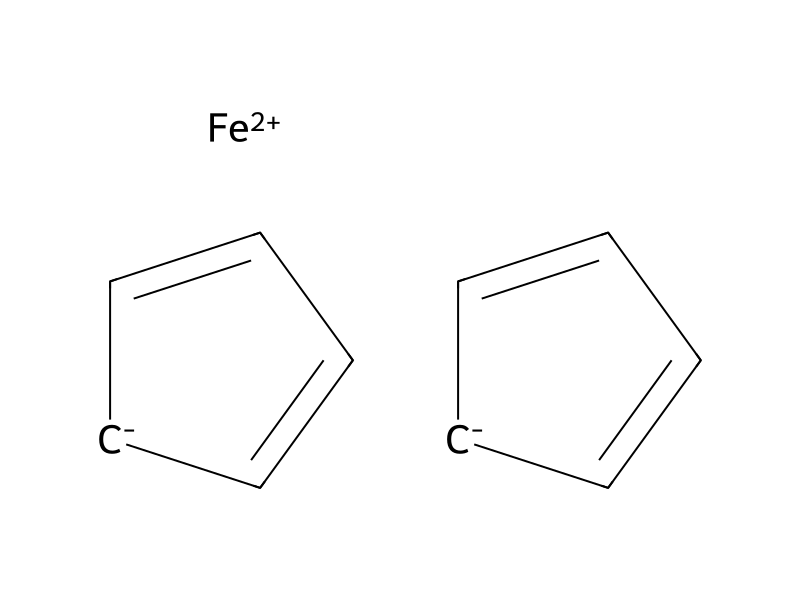


Conditions
- Temperature
- 375 °C
Procedure
An iron containing ZSM-5 catalyst was prepared by the following method: about 10 g of the same HZSM-5 as that of Example 1 was heated in a stream of dry air to 375° C. for 4 hours and then was cooled to room temperature. A solution of 0.3331 g of ferrocene (dicyclopentadienyliron) in 30 g dry toluene was then added to the dried zeolite and the slurry was mixed at room temperature overnight. The slurry was filtered and washed once with 100 ml of Tetralin® to remove excess ferrocene from the external surface of the zeolite. Excess Tetralin® was allowed to evaporate at room temperature to give a Tetralin®/ferrocene wetted zeolite. The recovered solid was then calcined in a stream of dry air at about 538° C. for about 6 hours to produce the desired iron containing catalyst, Catalyst C. The iron loading of this catalyst is about 0.66 wt. %.
Workup
- temperaturewas cooled to room temperature
- additionthe slurry was mixed at room temperature overnight
- filtrationThe slurry was filtered
- washwashed once with 100 ml of Tetralin®
- customto remove excess ferrocene from the external surface of the zeolite
- customto evaporate at room temperature
Sources & evidence
- ORD record
- ord-d0ff8142ad8641449bbb3fd09ddc931d
- Source dataset
- uspto-grants-1996_01
- Patent number
- US05482692
Reaction notes
Loading…