Trifluoroacetic acid → 1,3-Dichloro-6,7,8,9,10,12-hexahydroazepino[2,1-b]quinazolin-12-ol
Reaction equation

[Cl:1][C:2]1[CH:11]=[C:10]([Cl:12])[CH:9]=[C:8]2[C:3]=1[C:4](=[O:18])[N:5]1[CH2:17][CH2:16][CH2:15][CH2:14][CH2:13][C:6]1=[N:7]2.FC(F)(F)C(O)=O>C([SiH](CC)CC)C>[Cl:1][C:2]1[CH:11]=[C:10]([Cl:12])[CH:9]=[C:8]2[C:3]=1[CH:4]([OH:18])[N:5]1[CH2:17][CH2:16][CH2:15][CH2:14][CH2:13][C:6]1=[N:7]2Participants
4
Reactant 2


Product 1

Reagents, catalysts & solvents 1
Procedure
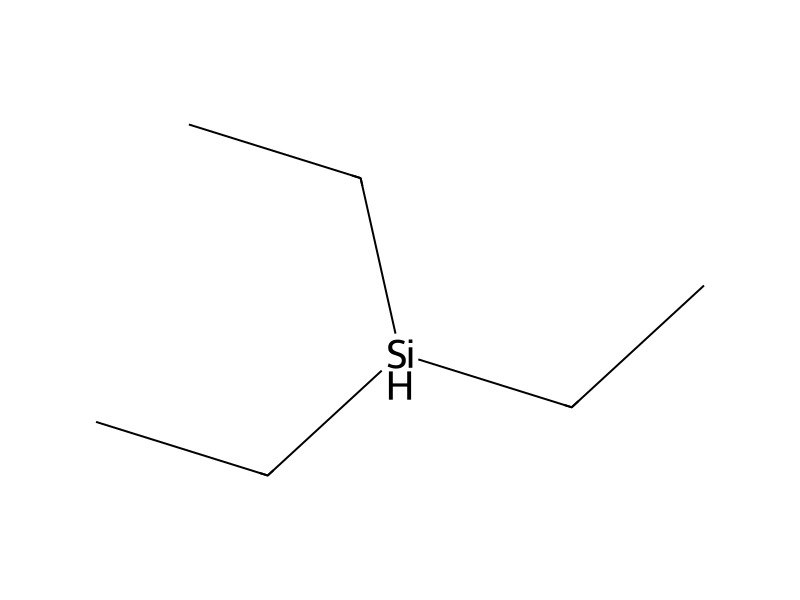
To a solution of 1 g of 1,3-dichloro-7,8,9,10-tetrahydroazepino[2,1-b]quinazolin-12(6H)-one in 30 mL of hot triethylsilane was added 5 m of trifluoroacetic acid and the mixture was stirred at 100° C.-110° C. under nitrogen. More triethylsilane and trifluoroacetic acid were added until the reaction was substantially complete as evidenced by TLC (basified aliquot extracted into CHCl3). Then all volatiles were removed in vacuo and the residue was basified, extracted into chloroform, and chromatographed using 20:1 chloroform:methanol on a silica gel column. Concentration of the corresponding fractions provided the desired 1,3-dichloro-6,7,8,9,10,12-hexahydroazepino[2,1-b]quinazolin-12-ol as a greyish-white solid.
Workup
- extractionbasified aliquot extracted into CHCl3)
- customThen all volatiles were removed in vacuo
- extractionextracted into chloroform
- customchromatographed
Sources & evidence
- ORD record
- ord-16bb6bff7b6e4ddeb4b2e9c0f327781b
- Source dataset
- uspto-grants-1996_01
- Patent number
- US05486512
Reaction notes
Loading…