Triethylamine → 2-(Pyridin-2-ylmethoxy)-isoindole-1.3-dione
Reaction equation

[OH:1][N:2]1[C:6](=[O:7])[C:5]2=[CH:8][CH:9]=[CH:10][CH:11]=[C:4]2[C:3]1=[O:12].Cl.[N:14]1[CH:19]=[CH:18][CH:17]=[CH:16][C:15]=1[CH2:20]Cl.C(N(CC)CC)C>C(#N)C>[N:14]1[CH:19]=[CH:18][CH:17]=[CH:16][C:15]=1[CH2:20][O:1][N:2]1[C:3](=[O:12])[C:4]2[C:5](=[CH:8][CH:9]=[CH:10][CH:11]=2)[C:6]1=[O:7]Participants
5
Reactant 3

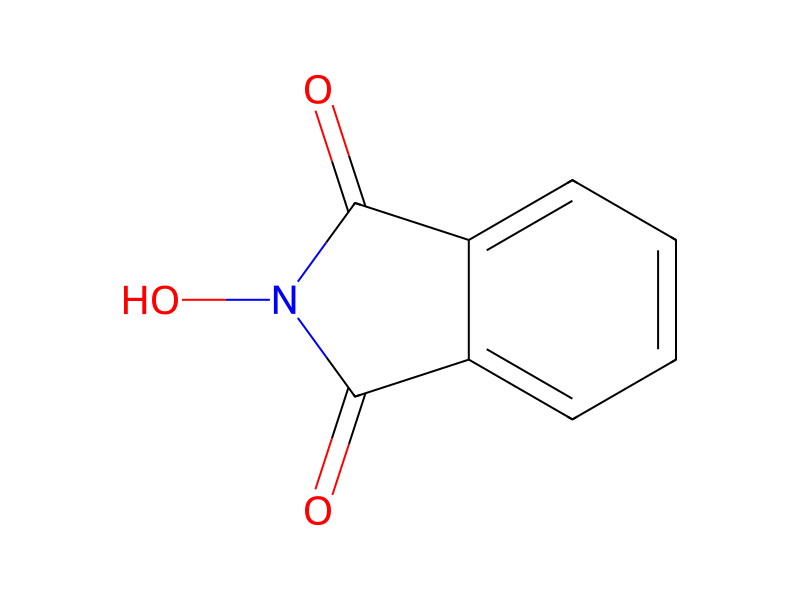

Product 1

Reagents, catalysts & solvents 1

Procedure
Under anhydrous conditions (positive nitrogen pressure, presence of 3Å molecular sieves), a mixture of N-hydroxyphthalimide (10.0 g, 0.061 mole), 2-picolylchloride hydrochloride (10.0 g, 0.061 mole), and triethylamine (18.5 g, 0.183 mol) in 100 ml of anhydrous acetonitrile was refluxed for 6 hours. After overnight stirring at ambient temperature, TLC showed that the starting materials were practically consumed. The solvent was evaporated and the residue dissolved in 200 ml of EtOAc. The solution was washed with 1N NaOH (100 ml), water (2×200 ml), brine (1×200 m ml) and dried (MgSO4). After removal of the solvent, the crude product was recrystallized from EtOAc/hexane to afford 11.4 g (73.6%) of title product.
Workup
- temperaturewas refluxed for 6 hours
- customwere practically consumed
- customThe solvent was evaporated
- dissolutionthe residue dissolved in 200 ml of EtOAc
- washThe solution was washed with 1N NaOH (100 ml), water (2×200 ml), brine (1×200 m ml)
- dry with materialdried (MgSO4)
- customAfter removal of the solvent
- customthe crude product was recrystallized from EtOAc/hexane
Sources & evidence
- ORD record
- ord-85accd8a31f14845bd4731fa3add635c
- Source dataset
- uspto-grants-1996_01
- Patent number
- US05488054
Reaction notes
Loading…