N-bromobutanimide → 2-Bromo-1-(pyrimidin-5-yl)ethan-1-one
Reaction equation

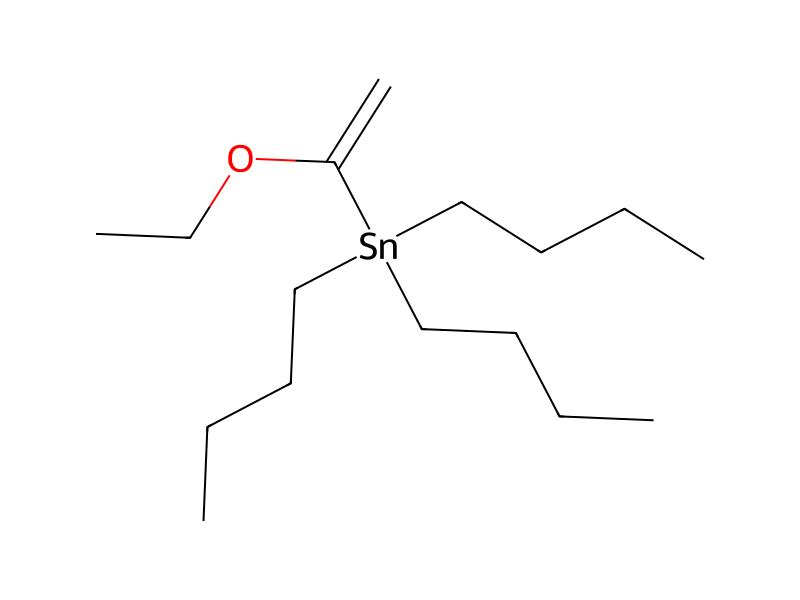
Br[C:2]1[CH:3]=[N:4][CH:5]=[N:6][CH:7]=1.[CH2:8]([O:10]C([Sn](CCCC)(CCCC)CCCC)=C)[CH3:9].[Br:26]N1C(=O)CCC1=O>C1(C)C=CC=CC=1.C1COCC1.O.C1C=CC([P]([Pd]([P](C2C=CC=CC=2)(C2C=CC=CC=2)C2C=CC=CC=2)([P](C2C=CC=CC=2)(C2C=CC=CC=2)C2C=CC=CC=2)[P](C2C=CC=CC=2)(C2C=CC=CC=2)C2C=CC=CC=2)(C2C=CC=CC=2)C2C=CC=CC=2)=CC=1>[Br:26][CH2:9][C:8]([C:2]1[CH:3]=[N:4][CH:5]=[N:6][CH:7]=1)=[O:10]Participants
Reactant 3


Product 1

Reagents, catalysts & solvents 4




Procedure
A mixture of 5-bromopyrimidine (2.20 g, 13.85 mmol), (1-ethoxyvinyl)tributyltin (5.00 g, 13.85 mmol), and tetrakis(triphenylphosphine)palladium (1.60 g, 1.38 mmol) in toluene (20 ml) was refluxed for 29 h, and then cooled to room temperature. The mixture was filtered through a pad of Celite and the filtrate was concentrated to give an oily residue. The residue was diluted with THF (30 ml) and water (8 ml). N-Bromosuccinimide (2.96 g, 16.61 mmol) was added at 0° C. The resulting mixture was stirred at 0° C. for 0.5 h and concentrated to ca. 10 ml. The residue was diluted with ethyl acetate (200 ml) and washed with water (100 ml×2), then dried (MgSO4). Removal of solvent gave an oily residue, which was purified by flash column chromatography eluting with ethyl acetate-hexane (1:3) to afford 2.60 g (94%) of the title compound as an oil.
Workup
- temperaturewas refluxed for 29 h
- filtrationThe mixture was filtered through a pad of Celite
- concentrationthe filtrate was concentrated
- customto give an oily residue
- concentrationconcentrated to ca. 10 ml
- additionThe residue was diluted with ethyl acetate (200 ml)
- washwashed with water (100 ml×2)
- dry with materialdried (MgSO4)
- customRemoval of solvent
- customgave an oily residue, which
- customwas purified by flash column chromatography
- washeluting with ethyl acetate-hexane (1:3)
Sources & evidence
- ORD record
- ord-7a3044a533084133b71ce7d51684945f
- Source dataset
- uspto-grants-2001_10
- Patent number
- US06300363B1
Reaction notes
Loading…