Bromine → HCID 68861002, compound
Reaction equation
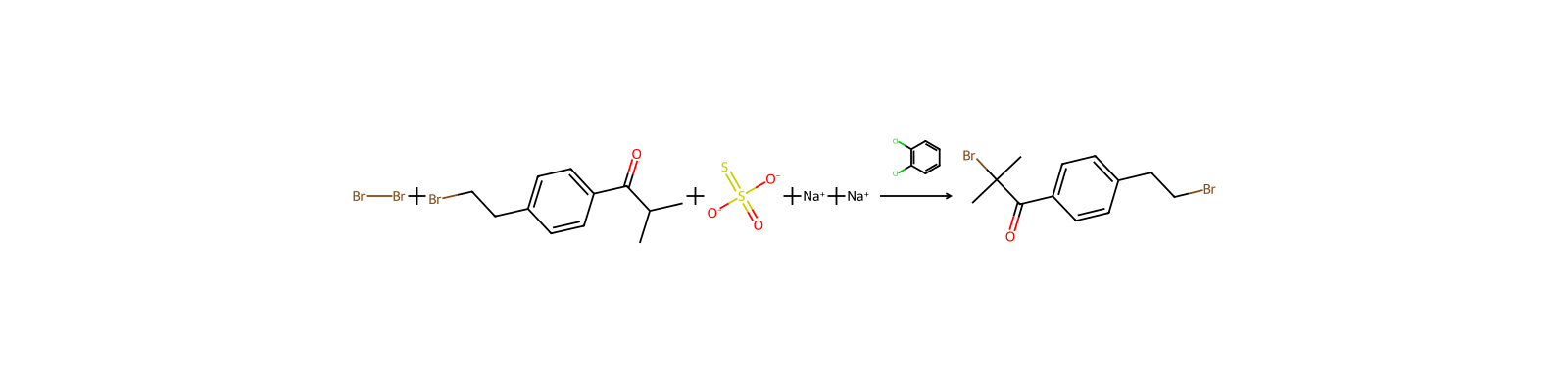
[Br:1]Br.[Br:3][CH2:4][CH2:5][C:6]1[CH:11]=[CH:10][C:9]([C:12](=[O:16])[CH:13]([CH3:15])[CH3:14])=[CH:8][CH:7]=1.S([O-])([O-])(=O)=S.[Na+].[Na+]>ClC1C=CC=CC=1Cl>[Br:1][C:13]([CH3:14])([CH3:15])[C:12]([C:9]1[CH:10]=[CH:11][C:6]([CH2:5][CH2:4][Br:3])=[CH:7][CH:8]=1)=[O:16]Participants
5
Reactant 3



Product 1

Reagents, catalysts & solvents 1

Procedure
A solution of 10 g of bromine in 25 ml of 1,2-dichlorobenzene is added drop wise at room temperature to 13.0 g (0.0509 mol) of crude 1-[4-(2-bromoethyl)phenyl]-2-methylpropan-1-one that is dissolved in 100 ml of 1,2-dichlorobenzene. The reaction mixture is stirred overnight, and then poured into a 5% sodium thiosulfate solution. The mixture is stirred for 30 minutes, and the organic layer is washed with 5% sodium thiosulfate solution, sodium bicarbonate solution, and distilled water. The organic layer is passed through a pad of silica gel and eluted with 9:1 heptane:ethyl acetate to give, after concentration, 7.5 g (55% yield) of 2-bromo-1-[4-(2-bromoethyl)phenyl]-2-methylpropan-1-one.
Workup
- stirringThe mixture is stirred for 30 minutes
- washthe organic layer is washed with 5% sodium thiosulfate solution, sodium bicarbonate solution
- distillationdistilled water
- washeluted with 9:1 heptane
- customethyl acetate to give
Sources & evidence
- ORD record
- ord-c04da690c26f4876a5ec5c07627d5689
- Source dataset
- uspto-grants-2013_02
- Patent number
- US08367743B2
Reaction notes
Loading…