Piperazine → 1-(4-tert-Butylphenyl)piperazine
Reaction equation

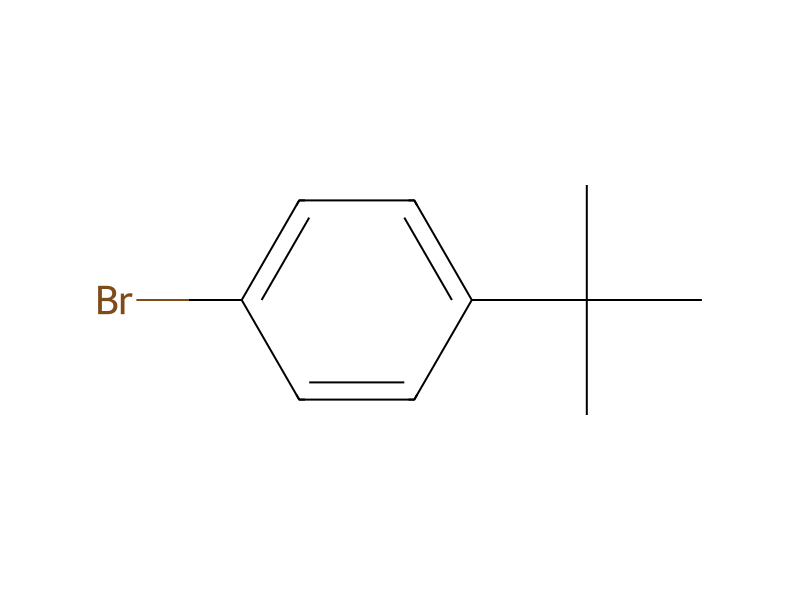
Br[C:2]1[CH:7]=[CH:6][C:5]([C:8]([CH3:11])([CH3:10])[CH3:9])=[CH:4][CH:3]=1.[NH:12]1[CH2:17][CH2:16][NH:15][CH2:14][CH2:13]1.CC(C)([O-])C.[Na+]>C1(C)C=CC=CC=1.CC1C=CC=CC=1[P](C1C=CC=CC=1C)([Pd](Cl)(Cl)[P](C1=C(C)C=CC=C1)(C1C=CC=CC=1C)C1C=CC=CC=1C)C1C=CC=CC=1C>[C:8]([C:5]1[CH:6]=[CH:7][C:2]([N:12]2[CH2:17][CH2:16][NH:15][CH2:14][CH2:13]2)=[CH:3][CH:4]=1)([CH3:11])([CH3:10])[CH3:9]Participants
6





Conditions
- Temperature
- 100 °C
Procedure
1-Bromo-4-t-butylbenzene (2.38 mL, 14 mmol), piperazine (1.8 g, 21 mmol), sodium t-butoxide (1.95 g, 20.3 mmol) and dichlorobis(tri-o-tolylphosphine)palladium(II) (330.1 mg, 0.42 mmol) were dissolved in anhydrous toluene and reacted for 3 hours while heating at 100° C. After identifying complete disappearance of 1-bromo-4-t-butylbenzene by TLC, the reaction solution was filtered with celite. The filtrate was concentrated and purified by separation through column chromatography (CH2Cl2/MeOH, 1:1). A target compound (1.47 g, 6.732 mmol, 48.2%) was yielded.
Workup
- customreacted for 3 hours
- filtrationthe reaction solution was filtered with celite
- concentrationThe filtrate was concentrated
- custompurified by separation through column chromatography (CH2Cl2/MeOH, 1:1)
Sources & evidence
- ORD record
- ord-d5a2f9ca450d48f7a7094e272f63522c
- Source dataset
- uspto-grants-2013_02
- Patent number
- US08383631B2
Reaction notes
Loading…