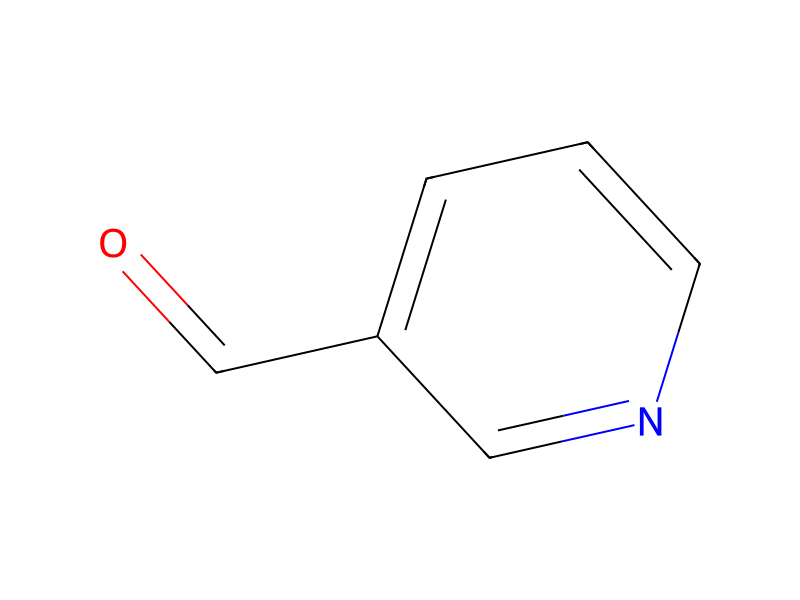
3-Pyridinecarboxaldehyde → HCID 11264150, compound
Reaction equation

[N:1]1[CH:6]=[CH:5][CH:4]=[C:3]([CH:7]=[O:8])[CH:2]=1.[F:9][C:10]1[CH:15]=[CH:14][C:13]([Mg]Br)=[CH:12][CH:11]=1>O1CCCC1.CCOCC>[F:9][C:10]1[CH:15]=[CH:14][C:13]([CH:7]([C:3]2[CH:2]=[N:1][CH:6]=[CH:5][CH:4]=2)[OH:8])=[CH:12][CH:11]=1Participants
Reactant 2

Product 1

Reagents, catalysts & solvents 2


Conditions
- Temperature
- 0 °C
Procedure
A solution of 3-pyridinecarboxaldehyde (5.32 g, 49.7 mmol) in tetrahydrofuran (100 ml) was cooled to-78° C. and treated dropwise with 25 ml (50 mmol) of a 2 M solution of 4-fluorophenyl magnesium bromide in ether. The reaction mixture was then slowly warmed up to 0° C. over 1 h and then quenched by the addition of saturated aqueous sodium bicarbonate and ethyl acetate. The organic phase was washed with brine, dried (magnesium sulfate) and concentrated under reduced pressure. Filtration of the residue on a short silica gel pad (elution ethyl acetate) followed by distillation in vacuo gave 9.42 g (93%) of the title material as a clear oil which crystallized upon standing. bp 120-130° C./0.2 torr (bulb to bulb distillation, air bath temperature), mp 45-47° C. 1HNMR 400 MHz (CDCl3) δ (ppm): 5.88 (1H, s, CH benzhydryl), 7.05 (2H, m, aromatics), 7.25-7.36 (3H, m, aromatics), 7.73 (1H, d, J=7.9 Hz, aromatic), 8.44 (1H, d, J=5.2 Hz, aromatic), 8.55 (1H, s, aromatic). Anal. Calcd for C12H10FNO: C, 70.92; H, 4.96; N, 6.89. Found: C, 70.61; H, 4.86; N, 6.71.
Workup
- customquenched by the addition of saturated aqueous sodium bicarbonate and ethyl acetate
- washThe organic phase was washed with brine
- dry with materialdried (magnesium sulfate)
- concentrationconcentrated under reduced pressure
- filtrationFiltration of the residue
- washon a short silica gel pad (elution ethyl acetate)
- distillationfollowed by distillation in vacuo
Sources & evidence
- ORD record
- ord-f451b16390a5411ab68589731e14e3f6
- Source dataset
- uspto-grants-2004_10
- Patent number
- US06803378B2
Reaction notes
Loading…