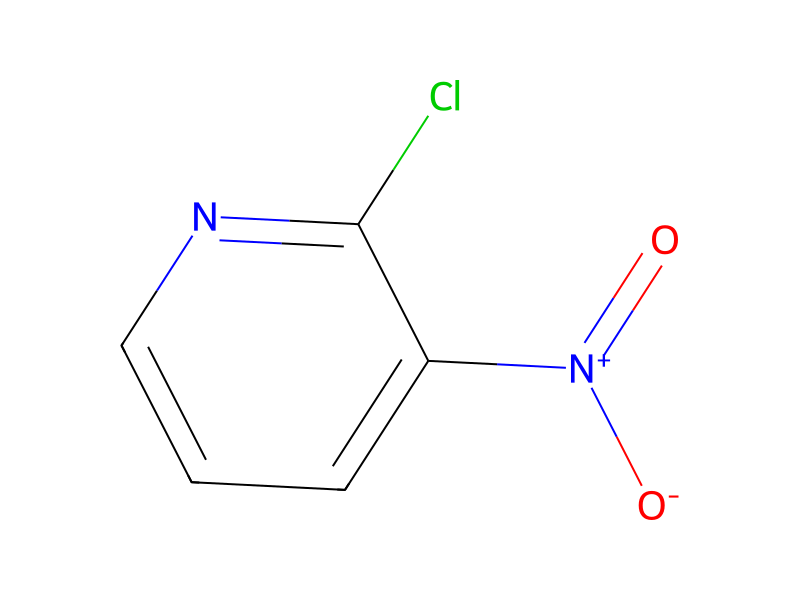
2-Chloro-3-nitropyridine → 3-Nitro-2-vinylpyridine
Reaction equation

Cl[C:2]1[C:7]([N+:8]([O-:10])=[O:9])=[CH:6][CH:5]=[CH:4][N:3]=1.[CH2:11]([Sn](CCCC)(CCCC)C=C)[CH2:12]CC.[Cl-].[Li+]>CN(C)C=O.Cl[Pd](Cl)([P](C1C=CC=CC=1)(C1C=CC=CC=1)C1C=CC=CC=1)[P](C1C=CC=CC=1)(C1C=CC=CC=1)C1C=CC=CC=1>[CH:11]([C:2]1[C:7]([N+:8]([O-:10])=[O:9])=[CH:6][CH:5]=[CH:4][N:3]=1)=[CH2:12]Participants
6





Conditions
- Temperature
- 90 °C
Procedure
Into a solution of the commercially available 2-chloro-3-nitropyridine (2 g, 12.6 mMol) in 5 mL of anhydrous N,N-dimethylformamide under inert atmosphere was added tributyl(vinyl)tin (4 mL, 13.87 mMol, 1.1 eq), lithium chloride (2.68 g, 50.46 mMol, 5 eq), and dichlorobis(triphenylphosphine)-palladium(II) (442 mg, 0.64 mMol, 5 Mol %). This was heated for 18 h at 90° C., concentrated in vacuo, and purified by flash silica gel chromatography using 10% ethyl acetate in hexanes as an eluent to afford the title compound as a brown oil (0.75 g).
Workup
- concentrationconcentrated in vacuo
- custompurified by flash silica gel chromatography
Sources & evidence
- ORD record
- ord-9e1bad6e651c43a592c8ee0e1afaaed6
- Source dataset
- uspto-grants-2003_08
- Patent number
- US06610692B1
Reaction notes
Loading…