Trichloroisocyanuric Acid → Decanal
Reaction equation

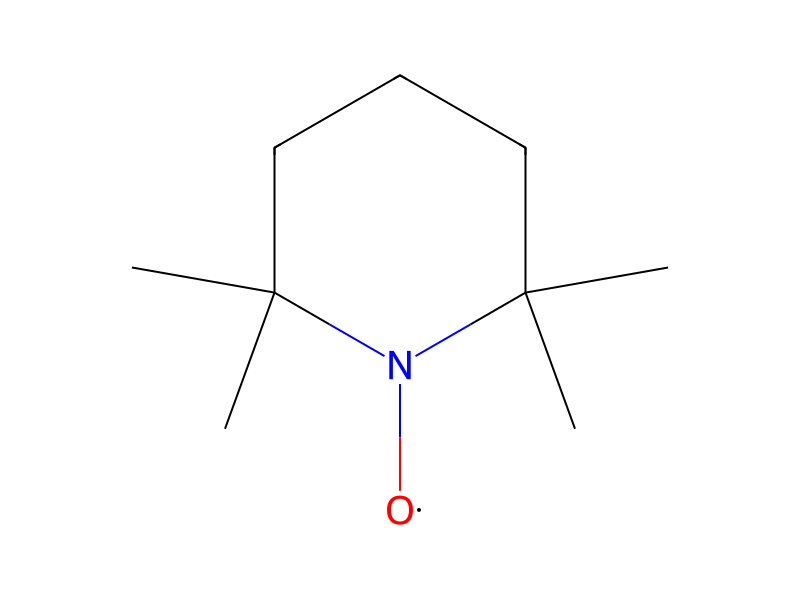
[CH2:1]([OH:11])[CH2:2][CH2:3][CH2:4][CH2:5][CH2:6][CH2:7][CH2:8][CH2:9][CH3:10].C([O-])(=O)C.[Na+].ClN1C(=O)N(Cl)C(=O)N(Cl)C1=O>C(Cl)Cl.CC1(C)N([O])C(C)(C)CCC1>[CH:1](=[O:11])[CH2:2][CH2:3][CH2:4][CH2:5][CH2:6][CH2:7][CH2:8][CH2:9][CH3:10]Participants
6
Reactant 3


Product 1

Reagents, catalysts & solvents 2

Conditions
- Temperature
- 0 °C
Procedure
6.08 g (38.4 mmol) of 1-decanol were dissolved in 58 ml of methylene chloride in a 200 ml sulphonation flask. 3.3 g (40.2 mmol) of sodium acetate and 3.6 g (15.5 mmol) of trichloroisocyanuric acid were added thereto. The mixture was cooled to 0° C. while stirring. A solution of 30 mg (0.12 mmol) of TEMPO derivative C in 3.5 ml of methylene chloride was dosed in within 30 minutes. The temperature was held at 0°-3° C. by constant cooling. The reaction had finished after 1 hour. The white precipitate was filtered off. The filtrate was worked up aqueous. 5.9 g (98%) of decanal were obtained as the crude product as a colourless liquid. GC content: 97% (area percent).
Workup
- customwas dosed in within 30 minutes
- customwas held at 0°-3° C. by constant cooling
- filtrationThe white precipitate was filtered off
Sources & evidence
- ORD record
- ord-53298379d49a44938508c9a5ac734917
- Source dataset
- uspto-grants-1998_10
- Patent number
- US05821374
Reaction notes
Loading…