Cyclohexanone → 2-[4-(trifluoromethyl)phenyl]cyclohexan-1-one
Reaction equation

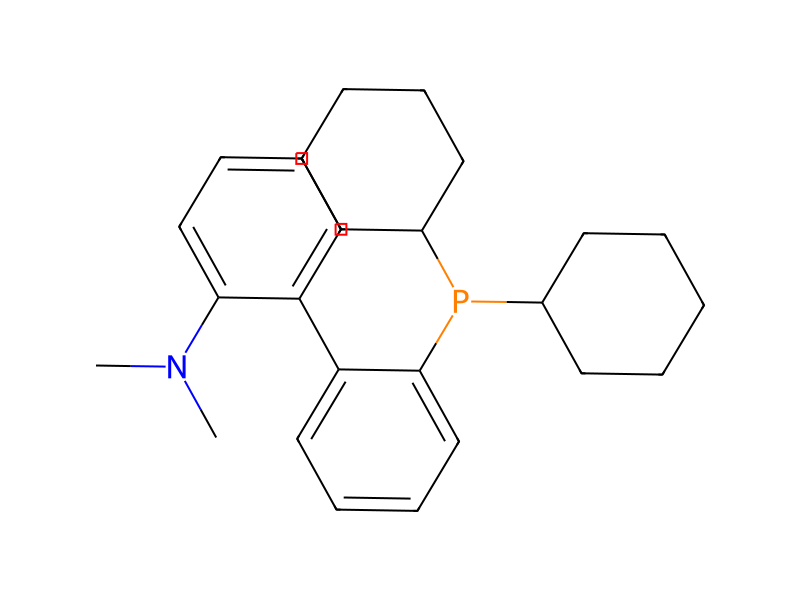
Br[C:2]1[CH:7]=[CH:6][C:5]([C:8]([F:11])([F:10])[F:9])=[CH:4][CH:3]=1.[C:12]1(=[O:18])[CH2:17][CH2:16][CH2:15][CH2:14][CH2:13]1.CC(C)([O-])C.[K+].C1(P(C2CCCCC2)C2C=CC=CC=2C2C=CC=CC=2N(C)C)CCCCC1>O1CCCC1.COC(C)(C)C>[F:9][C:8]([F:11])([F:10])[C:5]1[CH:6]=[CH:7][C:2]([CH:13]2[CH2:14][CH2:15][CH2:16][CH2:17][C:12]2=[O:18])=[CH:3][CH:4]=1Participants
7
Reactant 4



Product 1

Reagents, catalysts & solvents 2


Conditions
- Temperature
- 70 °C
Procedure
1-Bromo-4-trifluoromethylbenzene (5 mL), cyclohexanone (7.4 mL) and potassium tert-butoxide (8 g) were suspended in tetrahydrofuran (100 mL). Tris(dibenzylieneacetone)dipalladium (1.3 g) and 2-dicyclohexylphosphino-2′-(N,N-dimethylamino)biphenyl (843 mg) were added and the mixture was heated with stirring at 70° C. in a nitrogen atmosphere for 1.5 hours. After leaving to cool, tert-butyl methyl ether was added, followed by filtration through celite. The resulting organic layer was concentrated under reduced pressure. The residue was purified by silica gel column chromatography three times. The resulting solid was washed with heptane to obtain the title compound (2.1 g). The property values of the compound are as follows.
Workup
- temperaturethe mixture was heated
- customAfter leaving
- temperatureto cool
- filtrationfollowed by filtration through celite
- concentrationThe resulting organic layer was concentrated under reduced pressure
- customThe residue was purified by silica gel column chromatography three times
- washThe resulting solid was washed with heptane
Sources & evidence
- ORD record
- ord-19f20883b9a645e7a944d0cd86ec67a8
- Source dataset
- uspto-grants-2014_06
- Patent number
- US08754100B2
Reaction notes
Loading…