Methanol → Methyl 3-bromo-4-hydroxybenzoate
Reaction equation

[OH:1][C:2]1[CH:11]=[CH:10][C:5]([C:6]([O:8][CH3:9])=[O:7])=[CH:4][CH:3]=1.[Br:12]Br.S([O-])([O-])(=O)=S.[Na+].[Na+].CO>C(Cl)Cl>[Br:12][C:11]1[CH:10]=[C:5]([CH:4]=[CH:3][C:2]=1[OH:1])[C:6]([O:8][CH3:9])=[O:7]Participants
6
Reactant 4

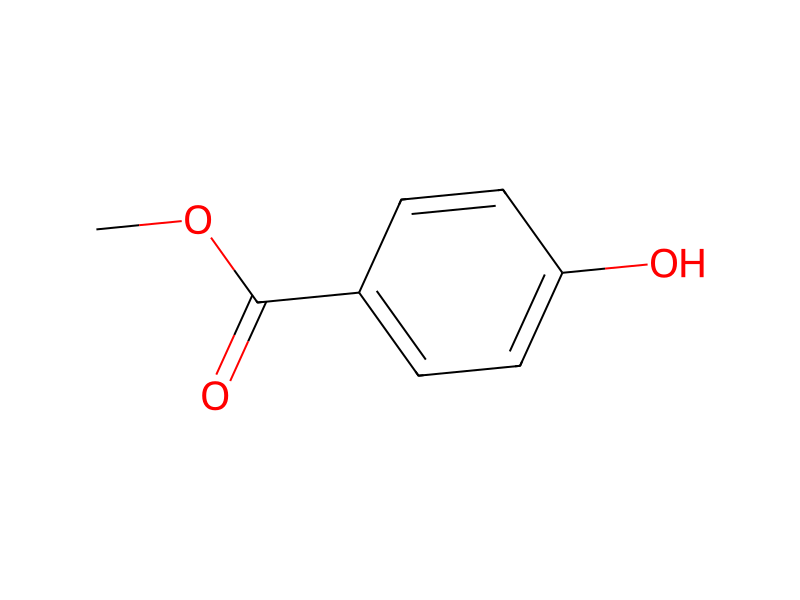


Product 1

Reagents, catalysts & solvents 1

Procedure
To a stirred suspension of methyl 4-hydroxybenzoate (180 g, 1183 mmol) in DCM (3 L) was added dropwise bromine (64 mL, 1242 mmol) under nitrogen and at 0° C. and the reaction mixture was left to stir at room temperature for 36 h. A solution of sodium thiosulfate (500 mL of a 10% solution) was then added while keeping the temperature around 15° C. followed by addition of MeOH (250 mL). The organic layer was washed with water, then brine, dried over MgSO4, filtered and concentrated to dryness to afford methyl 3-bromo-4-hydroxybenzoate (290 g) as a white solid. Mass Spectrum: m/z [M−H]−=229.
Workup
- waitat 0° C. and the reaction mixture was left
- customthe temperature around 15° C.
- washThe organic layer was washed with water
- dry with materialbrine, dried over MgSO4
- filtrationfiltered
- concentrationconcentrated to dryness
Sources & evidence
- ORD record
- ord-a8b1cd48e6ef4326836e5640efc10272
- Source dataset
- uspto-grants-2013_09
- Patent number
- US08530470B2
Reaction notes
Loading…