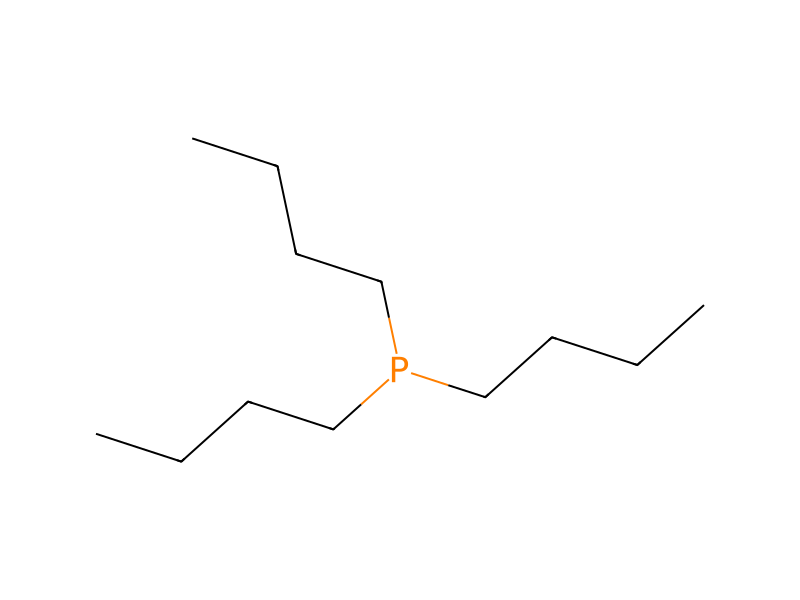
Tributylphosphine → HCID 18009110, compound
Reaction equation

CC(OC(/N=N/C(OC(C)(C)C)=O)=O)(C)C.C(P(CCCC)CCCC)CCC.[OH:30][C:31]1[CH:40]=[C:39]2[C:34]([CH:35]=[CH:36][CH:37]=[C:38]2[NH:41][C:42](=[O:55])[CH2:43][N:44]([CH2:52][CH2:53]O)[C:45]([O:47][C:48]([CH3:51])([CH3:50])[CH3:49])=[O:46])=[CH:33][CH:32]=1>O1CCCC1>[C:48]([O:47][C:45]([N:44]1[CH2:52][CH2:53][N:41]([C:38]2[C:39]3[C:34](=[CH:33][CH:32]=[C:31]([OH:30])[CH:40]=3)[CH:35]=[CH:36][CH:37]=2)[C:42](=[O:55])[CH2:43]1)=[O:46])([CH3:49])([CH3:51])[CH3:50]Participants
Reactant 3


Product 1

Reagents, catalysts & solvents 1

Procedure
To a solution of di-tert-butylazodicarboxylate (10.81 g, 43.2 mmol) in 60 mL of tetrahydrofuran at 0° C. was added tributylphosphine (10.76 mL, 43.2 mmol) dropwise. After 10 minutes, a solution of the crude product from Step B (ca. 28.8 mmol) in 30 mL of tetrahydrofuran was added dropwise, and the reaction was allowed to warm to room temperature. After two hours, HPLC analysis showed partial conversion. The solution was cooled to 0° C., and additional portions of tributylphosphine (3.0 mL, 18 mmol) and di-tert-butylazodicarboxylate (4.6 g, 18 mmol) were added. The reaction was warmed to room temperature, and stirred for 16 hours. The solution was concentrated in vacuo, and the resulting product was purified by isilica gel chromatography (0-5% MeOH/CH2Cl2) to provide the titled product as a dark brown foam, contaminated with tributylphosphine oxide impurity. This material was used in the next reaction without further purification.
Workup
- waitAfter two hours
- temperatureThe solution was cooled to 0° C.
- temperatureThe reaction was warmed to room temperature
- concentrationThe solution was concentrated in vacuo
- customthe resulting product was purified by isilica gel chromatography (0-5% MeOH/CH2Cl2)
Sources & evidence
- ORD record
- ord-d44df56b85a744ff8bf483ee1d8ca2f8
- Source dataset
- uspto-grants-2003_05
- Patent number
- US06562823B1
Reaction notes
Loading…