Cesium carbonate → 1-Cyclopropyl-3,5-dimethoxybenzene
Reaction equation

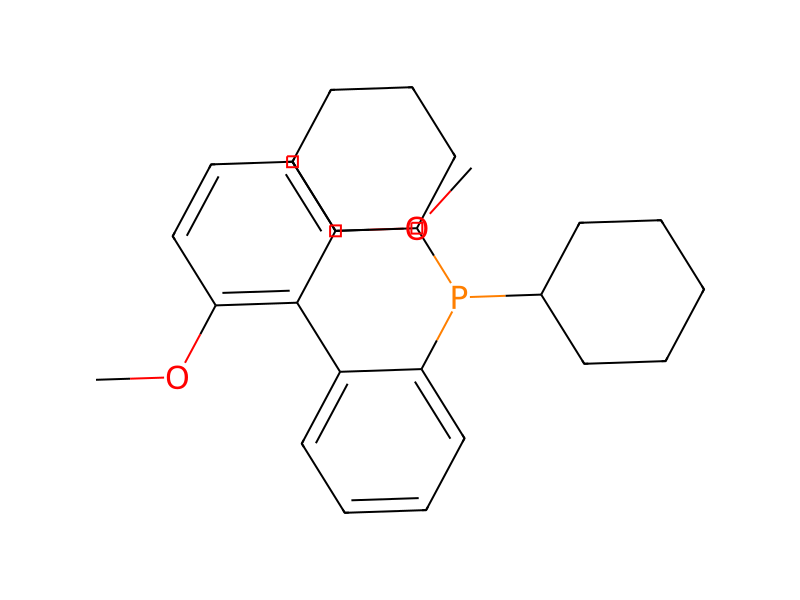
Br[C:2]1[CH:7]=[C:6]([O:8][CH3:9])[CH:5]=[C:4]([O:10][CH3:11])[CH:3]=1.C1(P(C2CCCCC2)[C:19]2C=CC=C[C:20]=2[C:25]2C(OC)=CC=CC=2OC)CCCCC1.C(=O)([O-])[O-].[Cs+].[Cs+]>O1CCOCC1.O.C([O-])(=O)C.[Pd+2].C([O-])(=O)C>[CH:25]1([C:2]2[CH:7]=[C:6]([O:8][CH3:9])[CH:5]=[C:4]([O:10][CH3:11])[CH:3]=2)[CH2:20][CH2:19]1Participants
7
Reactant 3


Product 1

Reagents, catalysts & solvents 3



Conditions
- Temperature
- 100 °C
Procedure
To a solution of 1-bromo-3,5-dimethoxybenzene (2.00 g, 9.21 mmol) in dioxane (30 mL) and water (10 mL) were added potassium cyclopropyl trifluoroborate (2.73 g, 18.4 mmol), 2-dicyclohexylphosphino-2′,6′-dimethoxybiphenyl (756 mg, 1.84 mmol), palladium(II) acetate (207 mg, 0.92 mmol) and cesium carbonate (18.0 g, 55.3 mmol), and the mixture was heated at 100° C. for 16 hours. After the reaction was completed, water was added to the reaction mixture, which was extracted with ethyl acetate and dried over anhydrous magnesium sulfate, and the solvent was distilled off under reduced pressure. The residue was purified by silica gel column chromatography (n-heptane/ethyl acetate: 3/1) to obtain the title compound (1.61 g, 9.03 mmol).
Workup
- extractionwas extracted with ethyl acetate
- dry with materialdried over anhydrous magnesium sulfate
- distillationthe solvent was distilled off under reduced pressure
- customThe residue was purified by silica gel column chromatography (n-heptane/ethyl acetate: 3/1)
Sources & evidence
- ORD record
- ord-1febc6efb69144cd885e0f3d583c497d
- Source dataset
- uspto-grants-2013_09
- Patent number
- US08530504B2
Reaction notes
Loading…