1,1'-Carbonyldiimidazole → HCID 44820418, compound
Reaction equation

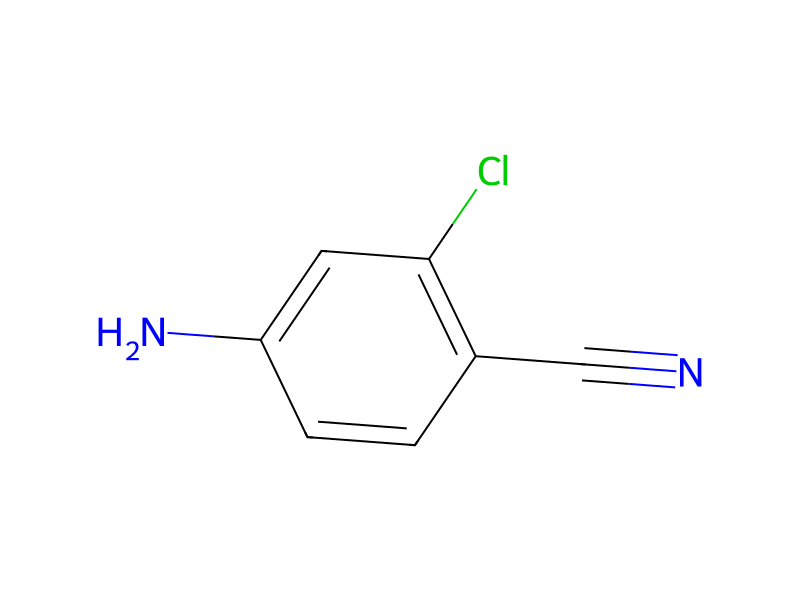
[Cl:1][C:2]1[CH:9]=[C:8]([NH2:10])[CH:7]=[CH:6][C:3]=1[C:4]#[N:5].[C:11]([N:18]1[CH:22]=[CH:21]N=C1)(N1C=CN=C1)=[O:12]>C1COCC1>[Cl:1][C:2]1[CH:9]=[C:8]([NH:10][C:11]([NH:18][C:22]2[CH:21]=[CH:6][C:3]([C:4]#[N:5])=[C:2]([Cl:1])[CH:9]=2)=[O:12])[CH:7]=[CH:6][C:3]=1[C:4]#[N:5]Participants
Reactant 2

Product 1

Reagents, catalysts & solvents 1

Conditions
- Temperature
- 60 °C
Procedure
2-Chloro-4-aminobenzonitrile (305.2 mg, 2 mmol) and carbonyldiimidazole (324 mg, 2 mmol) were combined in a reaction vial, and THF (3 mL) was added. The resulting mixture was heated overnight at 60° C., and the product, 1,3-bis-(3-chloro-4-cyano-phenyl)-urea was isolated by filtration and washed with several portions of 1N HCl to provide 220 mg (73% yield). This intermediate (200 mg, 0.6 mmol) was dispersed in DMF (2 mL) in a microwave vial, and a solution of 3-aminomethyl-N-(3-dimethylaminomethyl-benzyl)-benzamide (200 mg, 0.7 mmol), prepared in a fashion analogous to 3-aminomethyl-N-(4-dimethylaminomethyl-phenyl)-benzamide (Example 3), in DMF (1 mL), was added. The vial was sealed and heated in a microwave at 150° C. for 70 min. The reaction mixture was purified directly by preparative HPLC using an acetonitrile/water/formic acid gradient providing 76 mg of product which was contaminated with the aniline by-product. To remove the aniline, the mixture was dissolved in a solution of methanol/acetonitrile (20/80, 10 mL) and divided into 10 portions each of which were loaded directly onto a Varian 50 mg SCX cartridge. Each cartridge was washed with 2×2 mL acetonitrile and 2×2 mL methanol, then treated with NH3 in methanol (7N, 2 mL) to elute the pure title compound (60 mg, 18.4% yield), MS analysis electrospray, 462 (M+H).
Workup
- additionwas added
Sources & evidence
- ORD record
- ord-0eff110a4115429fb3b135b39a463b0e
- Source dataset
- uspto-grants-2012_01
- Patent number
- US08093266B2
Reaction notes
Loading…