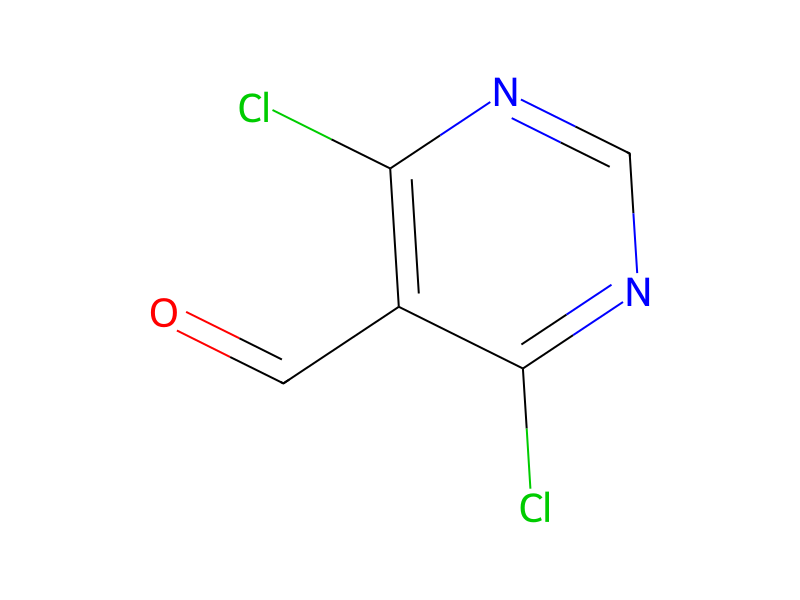
Acetone → 4,6-Dichloro-5-pyrimidinecarbaldehyde
Reaction equation

CN(C=O)C.O=P(Cl)(Cl)[Cl:8].[OH:11][C:12]1[CH:17]=[C:16](O)[N:15]=[CH:14][N:13]=1.CC(C)=O.[CH2:23]([Cl:25])Cl>>[Cl:8][C:16]1[C:17]([CH:12]=[O:11])=[C:23]([Cl:25])[N:13]=[CH:14][N:15]=1Participants
6





Conditions
- Temperature
- 0 °C
Procedure
Charge DMF (8.9 mL, 1.3 eq) in a round bottom flask and cool to 0° C. Add POCl3 (32.6 mL, 4.0 eq) to the reaction drop wise at 0° C. Stir the reaction mass at 0° C. for 1 h. Charge 4,6-dihydroxy pyrimidine (10.0 g, 1.0 eq) to the reaction mass and allowed it to come to room temperature slowly. Reflux the reaction mass for 4 h and monitor the reaction by TLC (10% acetone in DCM). Concentrate the reaction mass under vacuum and pour the concentrated reaction mass over crushed ice. Extract the product with diethyl ether and wash with saturated aq. sodium chloride. Dry the organic layer over anhydrous sodium sulfate and concentrate it under vacuum to get pale yellow solid as product (6.2 g, 40%).
Workup
- customwise at 0° C
- customto come to room temperature
- temperatureReflux the reaction mass for 4 h
- concentrationConcentrate the reaction mass under vacuum
- additionpour
- customthe concentrated reaction mass
- customover crushed ice
- extractionExtract the product with diethyl ether
- washwash with saturated aq. sodium chloride
- dry with materialDry the organic layer over anhydrous sodium sulfate
- concentrationconcentrate it under vacuum
- customto get pale yellow solid as product (6.2 g, 40%)
Sources & evidence
- ORD record
- ord-86a1070773684933b332ee8f1c4179f8
- Source dataset
- uspto-grants-2012_01
- Patent number
- US08093383B2
Reaction notes
Loading…