4-Chloroaniline → tert-Butyl 4-{[(4-chlorophenyl)amino]carbonyl}piperidine-1-carboxylate
Reaction equation

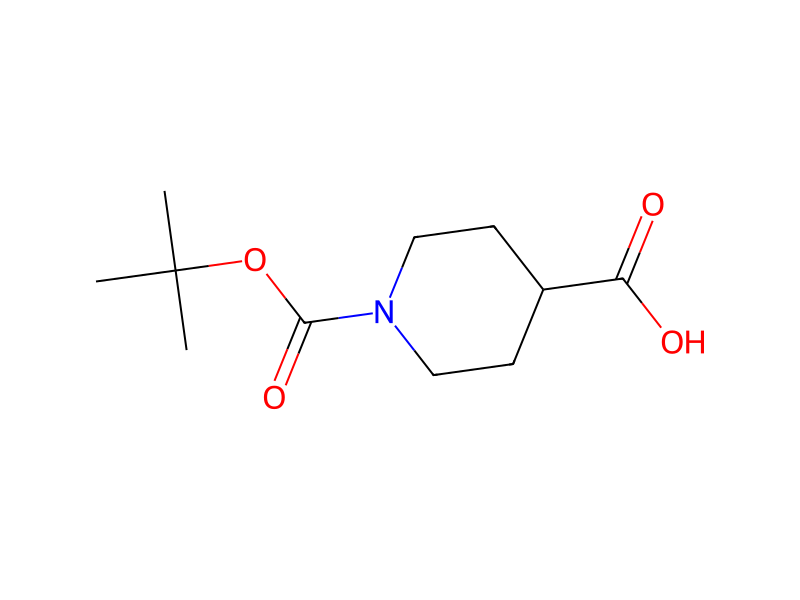
[C:1]([N:8]1[CH2:13][CH2:12][CH:11]([C:14]([OH:16])=O)[CH2:10][CH2:9]1)([O:3][C:4]([CH3:7])([CH3:6])[CH3:5])=[O:2].[Cl:17][C:18]1[CH:24]=[CH:23][C:21]([NH2:22])=[CH:20][CH:19]=1.Cl.CN(C)CCCN=C=NCC.C(N(CC)CC)C>C(#N)C>[Cl:17][C:18]1[CH:24]=[CH:23][C:21]([NH:22][C:14]([CH:11]2[CH2:10][CH2:9][N:8]([C:1]([O:3][C:4]([CH3:5])([CH3:6])[CH3:7])=[O:2])[CH2:13][CH2:12]2)=[O:16])=[CH:20][CH:19]=1Participants
6
Reactant 4



Product 1

Reagents, catalysts & solvents 1

Procedure
1-BOC-piperidine-4-carboxylic acid (100 g, 437 mmol), 4-chloroaniline (61.2 g, 480 mmol), 1-(3-dimethylaminopropyl)-3-ethylcarbodiimide hydrochloride (100 g, 524 mmol) and triethylamine (182.6 mL, 1.31 mol) were dissolved in cold (10° C.) acetonitrile (1.75 L). The reaction mixture was stirred for 54 hours at room temperature and then concentrated under reduced pressure. The residue was dissolved in ethyl acetate and then partitioned with 2N hydrochloric acid. The resulting precipitate was filtered off, re-dissolved in dichloromethane, the solution was dried over MgSO4 and evaporated under reduced pressure. The residue was triturated with ether to afford the desired compound as a white solid.
Workup
- concentrationconcentrated under reduced pressure
- dissolutionThe residue was dissolved in ethyl acetate
- custompartitioned with 2N hydrochloric acid
- filtrationThe resulting precipitate was filtered off
- dissolutionre-dissolved in dichloromethane
- dry with materialthe solution was dried over MgSO4
- customevaporated under reduced pressure
- customThe residue was triturated with ether
Sources & evidence
- ORD record
- ord-69f550a6f47248bc883e90b6f87f66d4
- Source dataset
- uspto-grants-2012_01
- Patent number
- US08093400B2
Reaction notes
Loading…