Potassium Acetate → Indole
Reaction equation

Br[C:2]1[CH:10]=[CH:9][CH:8]=[C:7]2[C:3]=1[CH:4]=[CH:5][NH:6]2.B(OB([O-])[O-])([O-])[O-].CC([O-])=O.[K+].CCOC(C)=O.CCCCCC>CS(C)=O.[Pd]>[NH:6]1[C:7]2[C:3](=[CH:2][CH:10]=[CH:9][CH:8]=2)[CH:4]=[CH:5]1Participants
Reactant 4




Product 1
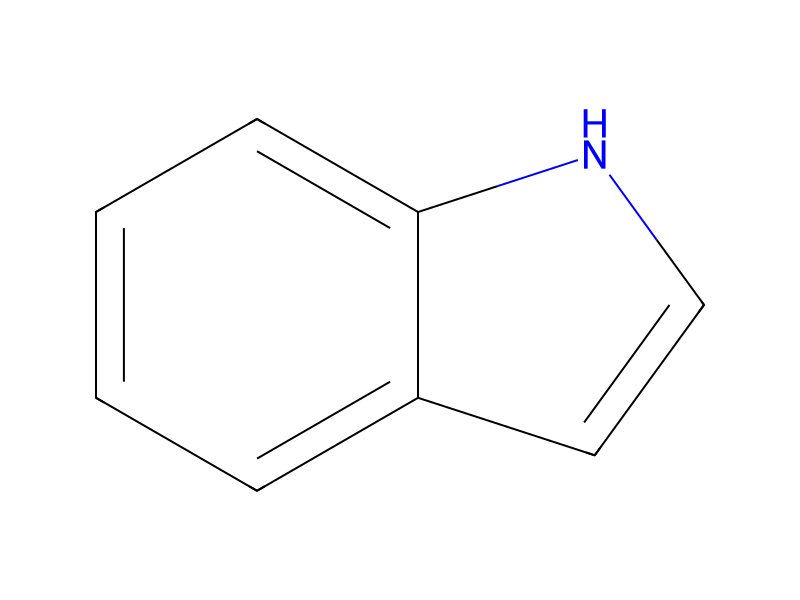
Reagents, catalysts & solvents 2


Conditions
- Temperature
- 80 °C
Procedure
To a mixture of 4-bromoindole (9.80 g, 50 mmol), pinacole diborate (13.97 g, 55 mmol), and KOAc (14.72 g, 150 mmol) in DMSO (200 mL) was added palladium catalyst PdCl2(dppf)CH2Cl2 (1.22 g, 1.5 mmol). The system was degassed, and then charged with nitrogen for three times. The mixture was stirred at 80° C. oil bath under nitrogen for 22 hours. TLC showed the complete disappearance of the starting material 4-bromoindole. The mixture was cooled to room temperature, and then poured to water (1 L). The product was extracted with ethyl acetate for three times. The combined extracts were washed by brine for five times to remove DMSO solvent, and then dried over Na2SO4. During the washing step, the catalyst may precipitate out, which was removed by filtration. The ethyl acetate solution was filtered and condensed. The residue was purified on a silica gel column eluting with EtOAc-hexane (9:1). The first fraction provided the side product indole (1.25 g, 21% yield), Rf 0.55 (EtOAc-Hexane 5:1). The second fraction provided 4-(4,4,5,5-Tetramethyl-[1,3,2]dioxaborolan-2-yl)-1H-indole as a white solid (8.01 g, 66%), Rf 0.46 (EtOAc-Hexane 5:1). 1H NMR (300 MHz, DMSO-d6): δ11.03 (bs, 1H, N—H)), 7.49 (d, J=7.7 Hz, 1H, H-5), 7.38 (dd, J=0.9 Hz, J=7.0 Hz, 1H, H-7), 7.38 (t, J=2.6 Hz, 1H, H-2), 7.06 (dd, J=7.7 Hz, J=7.0 Hz, 1H, H-6), 6.73 (bd, J 2.2 Hz; 1H, H-3), 1.32 (s, 12H, 4CH3); MS (m/e): 244 (M+H)+.
Workup
- customThe system was degassed
- additioncharged with nitrogen for three times
- temperatureThe mixture was cooled to room temperature
- additionpoured to water (1 L)
- extractionThe product was extracted with ethyl acetate for three times
- washThe combined extracts were washed by brine for five times
- customto remove DMSO solvent
- dry with materialdried over Na2SO4
- customDuring the washing step, the catalyst may precipitate out
- customwhich was removed by filtration
- filtrationThe ethyl acetate solution was filtered
- customcondensed
- customThe residue was purified on a silica gel column
- washeluting with EtOAc-hexane (9:1)
Sources & evidence
- ORD record
- ord-a05d082a27f0475aadd7e7ef1844e3a5
- Source dataset
- uspto-grants-2012_01
- Patent number
- US08106197B2
Reaction notes
Loading…