Hydrochloric Acid → 4-chloro-2-(cyclopentylamino)-N-(1-methyl-2-oxo-1,2,3,4-tetrahydroquinolin-7-yl)benzamide
Reaction equation

Cl.C(N=C=NCCCN(C)C)C.[Cl:13][C:14]1[CH:22]=[CH:21][C:17]([C:18]([OH:20])=O)=[C:16]([NH:23][CH:24]2[CH2:28][CH2:27][CH2:26][CH2:25]2)[CH:15]=1.[NH2:29][C:30]1[CH:39]=[C:38]2[C:33]([CH2:34][CH2:35][C:36](=[O:41])[N:37]2[CH3:40])=[CH:32][CH:31]=1>C(Cl)(Cl)Cl>[Cl:13][C:14]1[CH:22]=[CH:21][C:17]([C:18]([NH:29][C:30]2[CH:39]=[C:38]3[C:33]([CH2:34][CH2:35][C:36](=[O:41])[N:37]3[CH3:40])=[CH:32][CH:31]=2)=[O:20])=[C:16]([NH:23][CH:24]2[CH2:28][CH2:27][CH2:26][CH2:25]2)[CH:15]=1Participants
Reactant 4

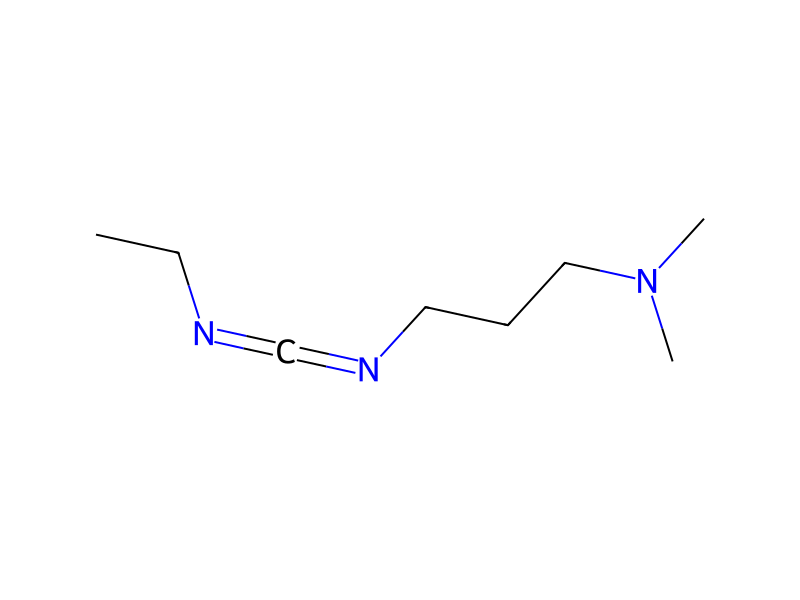


Product 1

Reagents, catalysts & solvents 1

Procedure
Hydrochloride of 1-ethyl-3-[3-(N,N-dimethylamino)propyl]carbodiimide (250 mg) was added to a chloroform (15 mL) solution of 4-chloro-2-(cyclopentylamino)benzoic acid (250 mg) and 7-amino-1-methyl-3,4-dihydroquinolin-2(1H)-one (184 mg), followed by stirring at room temperature for 26 hours. The reaction liquid was concentrated under a reduced pressure. By purifying the residue by silica gel column chromatography (chloroform:methanol, 1:0 to 9:1), 4-chloro-2-(cyclopentylamino)-N-(1-methyl-2-oxo-1,2,3,4-tetrahydroquinolin-7-yl)benzamide was obtained. By treating this with 4 M hydrogen chloride/ethyl acetate solution, 4-chloro-2-(cyclopentylamino)-N-(1-methyl-2-oxo-1,2,3,4-tetrahydroquinolin-7-yl)benzamide hydrochloride (97 mg) was obtained as a solid.
Workup
- customThe reaction liquid
- concentrationwas concentrated under a reduced pressure
- customBy purifying the residue by silica gel column chromatography (chloroform:methanol, 1:0 to 9:1)
Sources & evidence
- ORD record
- ord-a35e260f35a646f881fcf39b8ab60da4
- Source dataset
- uspto-grants-2012_01
- Patent number
- US08106190B2
Reaction notes
Loading…