Sodium Carbonate → 4-Chloro-5-cyclopropyl-2,6-dimethoxy-pyrimidine
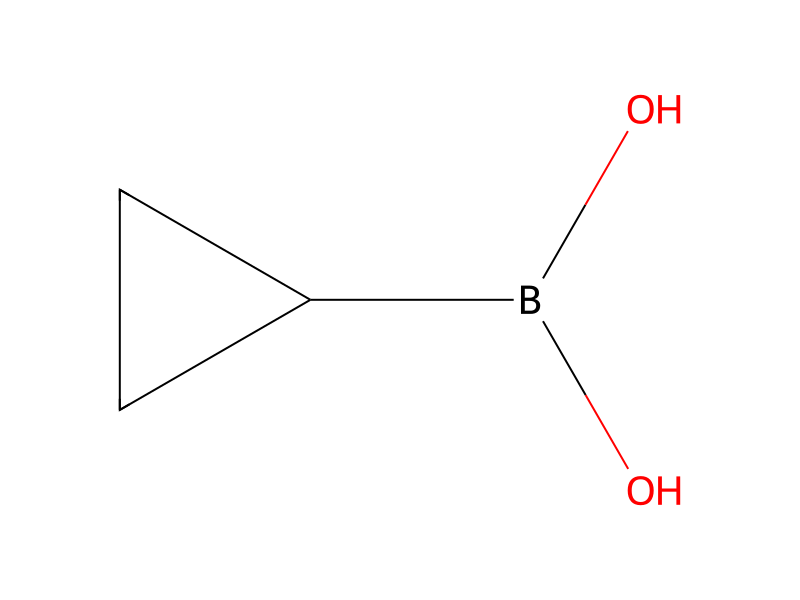
Reaction equation

Br[C:2]1[C:3]([Cl:12])=[N:4][C:5]([O:10][CH3:11])=[N:6][C:7]=1[O:8][CH3:9].[CH:13]1(B(O)O)[CH2:15][CH2:14]1.ClCl.C([O-])([O-])=O.[Na+].[Na+]>[Pd].C1C=CC(P(C2C=CC=CC=2)[C-]2C=CC=C2)=CC=1.C1C=CC(P(C2C=CC=CC=2)[C-]2C=CC=C2)=CC=1.[Fe+2].C(OCC)(=O)C.COCCOC>[Cl:12][C:3]1[C:2]([CH:13]2[CH2:15][CH2:14]2)=[C:7]([O:8][CH3:9])[N:6]=[C:5]([O:10][CH3:11])[N:4]=1Participants
9
Reactant 4



Product 1

Reagents, catalysts & solvents 4




Conditions
- Temperature
- 130 °C
Procedure
In a 5 mL microwave reaction tube, 5-bromo-4-chloro-2,6-dimethoxy-pyrimidine (116 mg, 0.457 mmol), cyclopropyl boronic acid (47 mg, 0.549 mmol, 1.2 eq.) and Pd(dppf(Cl2 (38 mg, 0.1 eq.) was charged with DME (2.5 mL) and 2M Na2CO3 aqueous solution (0.91 mL, 4 eq.). The reaction was heated at 130° C. in the microwave reactor for 30 minutes. Ethyl acetate was added, followed by washing with brine. The organic layer was concentrated down and purified (silica gel, 0-50% EtOAC/hexane) to give white solid (64 mg, 65%). LC-MS shows 215.1 (M+1). 1H NMR (300 MHz, CDCl3): δ 3.98 (dd, 6H), 1.62 (m, 1H), 0.99 (m, 2H), 0.78 (m, 2H).
Workup
- washby washing with brine
- concentrationThe organic layer was concentrated down
- custompurified (silica gel, 0-50% EtOAC/hexane)
Sources & evidence
- ORD record
- ord-c5ba8d2c36214879b6a22c42ec5498a5
- Source dataset
- uspto-grants-2012_01
- Patent number
- US08106064B2
Reaction notes
Loading…