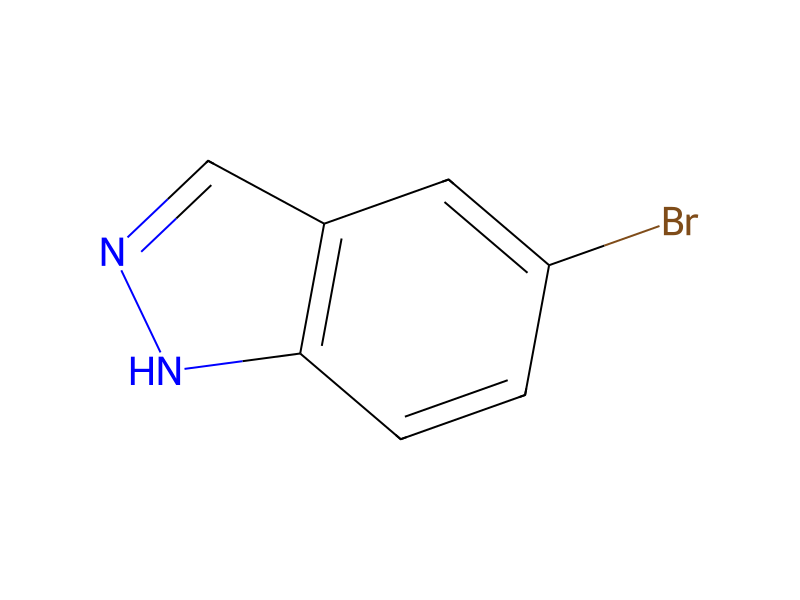
Acetic Anhydride → 5-bromo-1H-indazole
Reaction equation

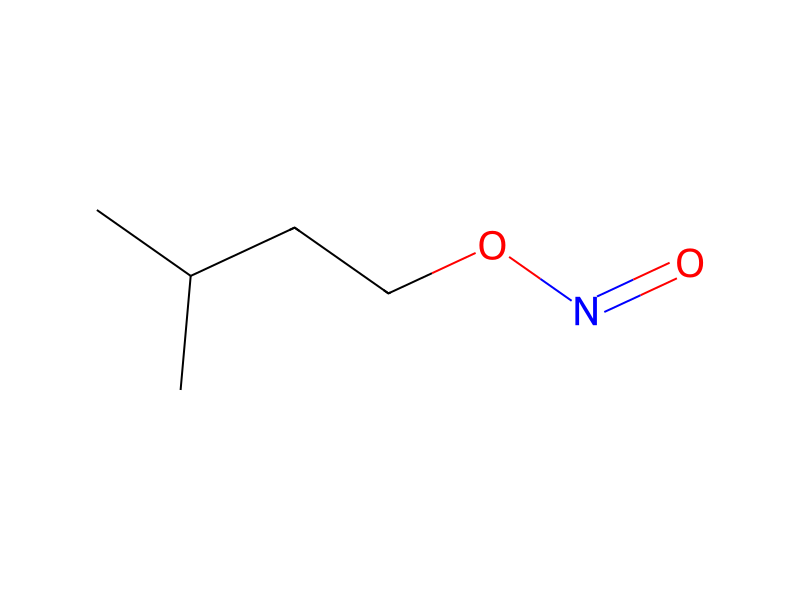
[Br:1][C:2]1[CH:8]=[CH:7][C:5]([NH2:6])=[C:4]([CH3:9])[CH:3]=1.C(OC(=O)C)(=O)C.C([O-])(=O)C.[K+].[N:22](OCCC(C)C)=O>C(Cl)(Cl)Cl>[Br:1][C:2]1[CH:3]=[C:4]2[C:5](=[CH:7][CH:8]=1)[NH:6][N:22]=[CH:9]2Participants
Reactant 4



Product 1
Reagents, catalysts & solvents 1

Conditions
- Temperature
- 68 °C
Procedure
A flask containing 4-bromo-2-methylaniline (95.0 g) in chloroform (0.70 L) was treated with acetic anhydride (0.109 L) at <40° C. The solution was stirred for 50 minutes and potassium acetate (14.6 g) and isoamyl nitrite (0.147 L) was charged. The solution was refluxed at 68° C. for 20 h. The temperature was cooled to 25° C. and the volatiles distilled at 30 mmHg vacuum (T=30-40° C.). Once most of the solvents had distilled, a total of 225 mL of water was charged in portions and the azeotrope of water and the various volatiles distilled. The product mass was transferred back into the reaction vessel using water (50 mL) and concentrated hydrochloric acid (400 mL) charged. The mixture was heated to 50-55° C. and another 100 mL acid charged in portions over 2 h. The solution was cooled to 20° C. and 50% sodium hydroxide (520 g) was charged at <37° C. to bring the pH to 11. Water (100 mL) and ethyl acetate (350 mL) was added and the mixture filtered through a Celite pad. The layers were separated and the aqueous phase further extracted with ethyl acetate (2×200 mL). The combined organic layers were mixed with brine (240 mL), filtered through a Celite pad and separated. The organic solution was dried over magnesium sulfate (3 g) and filtered through a silica gel pad (45 g) with ethyl acetate. The eluant was concentrated by rotary evaporation, adding a total of 0.45 L of heptane during the distillation and continueing until only dry solids remain. The solids were slurried with heptane (0.1 L), filtered and dried under vacuum at 45° C. to produce 91.9 g of 5-bromoindazole (94% yield).
Workup
- temperatureThe temperature was cooled to 25° C.
- distillationthe volatiles distilled at 30 mmHg vacuum (T=30-40° C.)
- distillationOnce most of the solvents had distilled
- additiona total of 225 mL of water was charged in portions
- distillationthe azeotrope of water and the various volatiles distilled
- additioncharged
- temperatureThe mixture was heated to 50-55° C.
- additionanother 100 mL acid charged in portions over 2 h
- temperatureThe solution was cooled to 20° C.
- addition50% sodium hydroxide (520 g) was charged at <37° C.
- additionWater (100 mL) and ethyl acetate (350 mL) was added
- filtrationthe mixture filtered through a Celite pad
- customThe layers were separated
- extractionthe aqueous phase further extracted with ethyl acetate (2×200 mL)
- additionThe combined organic layers were mixed with brine (240 mL)
- filtrationfiltered through a Celite pad
- customseparated
- dry with materialThe organic solution was dried over magnesium sulfate (3 g)
- filtrationfiltered through a silica gel pad (45 g) with ethyl acetate
- concentrationThe eluant was concentrated by rotary evaporation
- additionadding a total of 0.45 L of heptane
- distillationduring the distillation
- filtrationfiltered
- customdried under vacuum at 45° C.
Sources & evidence
- ORD record
- ord-b3c83ae66c1e479c926286d703743fd2
- Source dataset
- uspto-grants-2001_11
- Patent number
- US06313110B1
Reaction notes
Loading…