Catechol → Ethyl 2,3-dihydro-1,4-benzodioxine-2-carboxylate
Reaction equation

Br[CH:2]([CH2:8]Br)[C:3]([O:5][CH2:6][CH3:7])=[O:4].C(=O)([O-])[O-].[K+].[K+].[C:16]1([C:18](=[CH:20][CH:21]=[CH:22][CH:23]=1)[OH:19])[OH:17]>CC(C)=O>[O:17]1[C:16]2[CH:23]=[CH:22][CH:21]=[CH:20][C:18]=2[O:19][CH2:8][CH:2]1[C:3]([O:5][CH2:6][CH3:7])=[O:4]Participants
5
Reactant 3


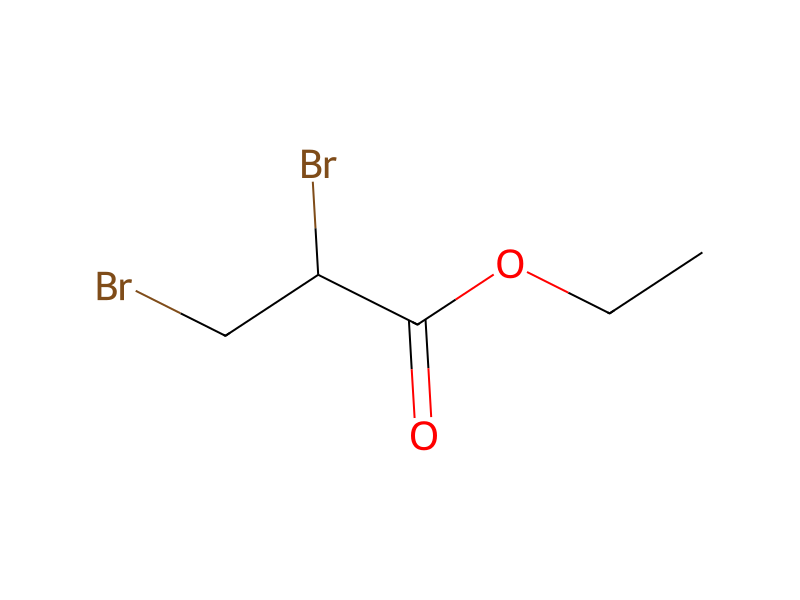
Product 1

Reagents, catalysts & solvents 1

Procedure
26 g (100 mmol) of ethyl 2,3-dibromopropionate and 36.4 g (264 mmol) of anhydrous potassium carbonate are added to 40 g (181 mmol) of catechol dissolved in 200 ml of anhydrous acetone. The operation is repeated 4 times within one hour; the reaction mixture is then heated to boiling. After 18 hours at reflux under argon, the mixture is cooled and then filtered over Celite. After concentration of the filtrate in vacuo, the residue is hydrolysed and then the aqueous phase is extracted with ether. The organic phase is dried over magnesium sulphate and then concentrated in vacuo. The title ester is obtained pure by distillation under reduced pressure (15 mm Hg; b.p.=155° C.).
Workup
- customwithin one hour
- temperaturethe reaction mixture is then heated to boiling
- temperatureAfter 18 hours at reflux under argon
- temperaturethe mixture is cooled
- filtrationfiltered over Celite
- extractionthe aqueous phase is extracted with ether
- dry with materialThe organic phase is dried over magnesium sulphate
- concentrationconcentrated in vacuo
Sources & evidence
- ORD record
- ord-5eef8a8b7b4140ec9b07bd127d9551dc
- Source dataset
- uspto-grants-2001_11
- Patent number
- US06313160B1
Reaction notes
Loading…