Hydrochloric Acid → HCID 15391779, compound
Reaction equation
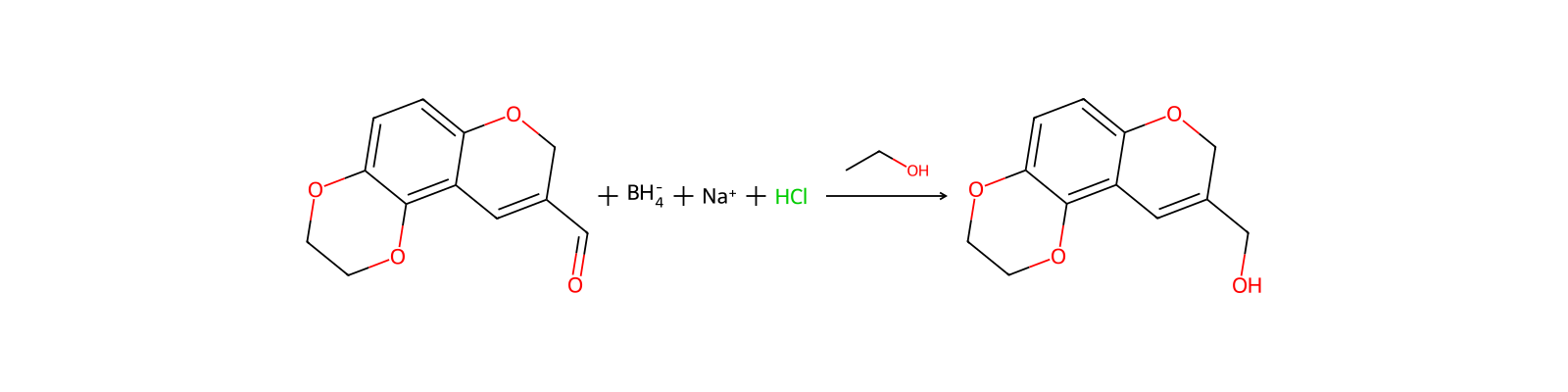
[O:1]1[C:6]2=[C:7]3[C:12](=[CH:13][CH:14]=[C:5]2[O:4][CH2:3][CH2:2]1)[O:11][CH2:10][C:9]([CH:15]=[O:16])=[CH:8]3.[BH4-].[Na+].Cl>C(O)C>[O:1]1[C:6]2=[C:7]3[C:12](=[CH:13][CH:14]=[C:5]2[O:4][CH2:3][CH2:2]1)[O:11][CH2:10][C:9]([CH2:15][OH:16])=[CH:8]3Participants
5
Reactant 3



Product 1

Reagents, catalysts & solvents 1

Procedure
2.18 g (10 mmol) of the aldehyde obtained in Step C are dissolved in 25 ml of anhydrous ethanol and then 0.38 g (10 mmol) of sodium borohydride is added to the medium. After 15 minutes of stirring, the solvent is evaporated in vacuo; the residue obtained is then acidified with a 1N hydrochloric acid solution. The aqueous phase is extracted with dichloromethane; the organic phase is then dried over magnesium sulphate and then concentrated under reduced pressure. The crude product is passed over a silica column (eluant:petroleum ether/ethyl acetate:70/30 then 50/50) to yield the title alcohol in the form of a clear syrup.
Workup
- customthe solvent is evaporated in vacuo
- customthe residue obtained
- extractionThe aqueous phase is extracted with dichloromethane
- dry with materialthe organic phase is then dried over magnesium sulphate
- concentrationconcentrated under reduced pressure
Sources & evidence
- ORD record
- ord-db7ebe697ea248e88bc67c4b6e26256f
- Source dataset
- uspto-grants-2001_11
- Patent number
- US06313160B1
Reaction notes
Loading…