4-Chlorobenzaldehyde → 4-[(4-Chlorobenzyl)oxy]benzaldehyde
Reaction equation

[Cl:1][C:2]1[CH:9]=[CH:8][C:5]([CH:6]=[O:7])=[CH:4][CH:3]=1>CC1C=CC=CC=1C>[Cl:1][C:2]1[CH:9]=[CH:8][C:5]([CH2:6][O:7][C:2]2[CH:9]=[CH:8][C:5]([CH:6]=[O:7])=[CH:4][CH:3]=2)=[CH:4][CH:3]=1Participants
Reactant 1
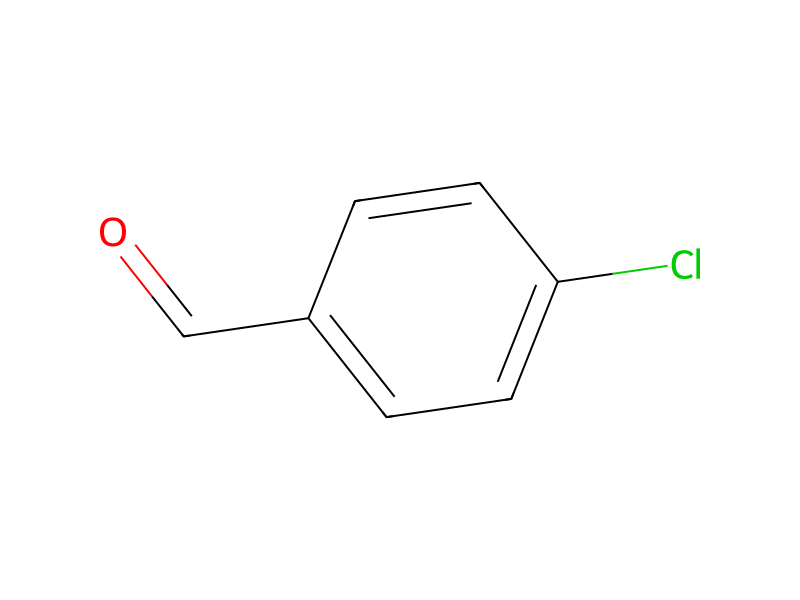
Product 1

Reagents, catalysts & solvents 1

Conditions
- Temperature
- 80 °C
Procedure
In a 200-ml eggplant-type flask, 5.3 g (37.0 mmol) of 4-chlorobenzyl alcohol were weighed. After 80 ml of o-xylene, a nonpolar solvent, were added to form a solution, 28.0 g (37.0 mmol) of tetrakis[tris(dimethylamino)phosphoranilideneamino]phosphonium hydroxide was added to form a homogeneous solution. The solution was heated to 80° C., at which it was then maintained at 5 mmHg for 1 hour. Its pressure was allowed to rise back to normal pressure by nitrogen, followed by cooling to room temperature. Further, 50 ml of o-xylene and 5.20 g (37.0 mmol) of 4-chlorobenzaldehyde were added, followed by heating at 130° C. for 96 hours. The reaction mixture was washed four times with 100-ml portions of 1 N hydrochloric acid. The organic layer was separated and then concentrated to dryness. The residue was recrystallized from ethanol, whereby 5.6 g of 4-(4-chlorobenzyloxy)benzaldehyde were obtained as colorless crystals. Its isolation yield was 61%.
Workup
- additionwas added
- customto form a homogeneous solution
- temperaturewas then maintained at 5 mmHg for 1 hour
- temperatureby cooling to room temperature
- temperatureby heating at 130° C. for 96 hours
- washThe reaction mixture was washed four times with 100-ml portions of 1 N hydrochloric acid
- customThe organic layer was separated
- concentrationconcentrated to dryness
- customThe residue was recrystallized from ethanol
Sources & evidence
- ORD record
- ord-8e00a46283014b658f47fa88f794b879
- Source dataset
- uspto-grants-2003_12
- Patent number
- US06664365B2
Reaction notes
Loading…