2,6-Dibromopyridine → 2-Acetyl-6-bromopyridine
Reaction equation

Br[C:2]1[CH:7]=[CH:6][CH:5]=[C:4]([Br:8])[N:3]=1.[Li]CCCC.CN(C)[C:16](=[O:18])[CH3:17].[NH4+].[Cl-]>C1CCCCC1.CCOCC>[C:16]([C:2]1[CH:7]=[CH:6][CH:5]=[C:4]([Br:8])[N:3]=1)(=[O:18])[CH3:17]Participants
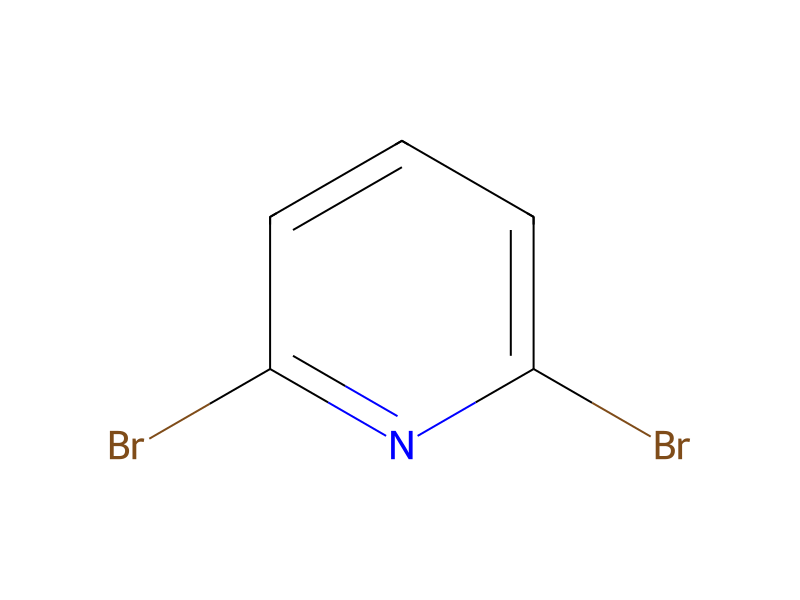






Conditions
- Temperature
- -78 °C
Procedure
To a solution of 3.00 g (12.7 mmol) of 2,6-dibromopyridine in 20 mL anhydrous. Et2O at −78° C. was added dropwise over 30 min. 8.0 mL (12.8 mmol) of 1.6 M n-BuLi in cyclohexane. After stirring for 3 h at −78° C., 8.2 mL (88 mmol) of N,N-dimethylacetamide was added dropwise and the solution was stirred at −78° C. for 1 h. On warming to RT, Et2O (100 mL) and saturated aqueous NH4Cl (50 mL) were added and the layers were separated. The organic layer was dried over Na2SO4 and the volatiles were removed by rotary evaporation. The resulting yellow solid was recrystallized from hexanes to provide 1.8 g (71%) of 2-acetyl-6-bromopyridine as colorless crystals. 1H NMR (CDCl3): σ2.81 (s, 3H); 7.67-7.77 (m, 2 H); 8.22 (dd, J=6.8, 1.6 Hz, 1 H). Mass Spec.: m/e 200.
Workup
- stirringthe solution was stirred at −78° C. for 1 h
- temperatureOn warming to RT
- customthe layers were separated
- dry with materialThe organic layer was dried over Na2SO4
- customthe volatiles were removed by rotary evaporation
- customThe resulting yellow solid was recrystallized from hexanes
Sources & evidence
- ORD record
- ord-a28b0e00875b47e395ae96294b8a7dd7
- Source dataset
- uspto-grants-2003_12
- Patent number
- US06670298B1
Reaction notes
Loading…