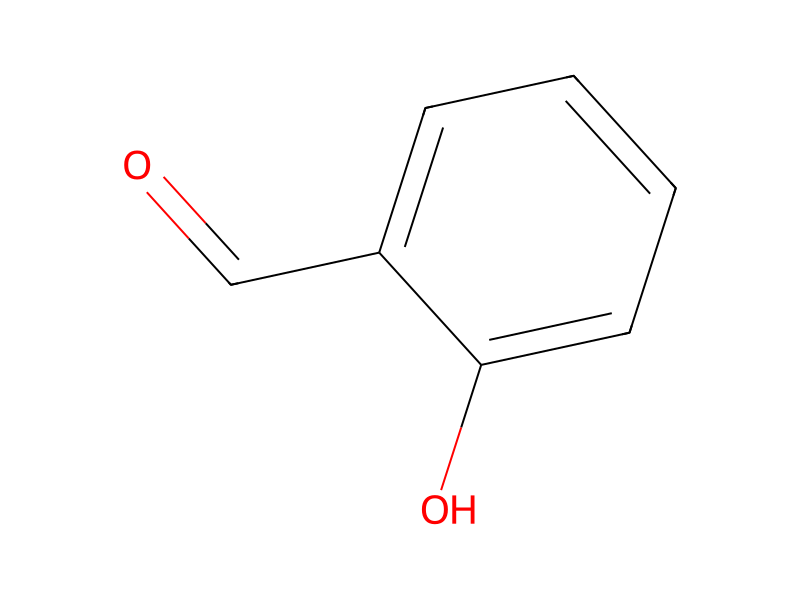
Salicylaldehyde → 4-(2-Hydroxybenzylideneamino)-3,5-dimethylphenol
Reaction equation

[NH2:1][C:2]1[C:7]([CH3:8])=[CH:6][C:5]([OH:9])=[CH:4][C:3]=1[CH3:10].[CH:11](=O)[C:12]1[C:13](=[CH:15][CH:16]=[CH:17][CH:18]=1)[OH:14].C(OCC)(=O)C>CCCCCC>[OH:14][C:13]1[CH:15]=[CH:16][CH:17]=[CH:18][C:12]=1[CH:11]=[N:1][C:2]1[C:7]([CH3:8])=[CH:6][C:5]([OH:9])=[CH:4][C:3]=1[CH3:10]Participants
Reactant 3


Product 1

Reagents, catalysts & solvents 1

Conditions
- Temperature
- 55 °C
Procedure
To a 500 milliliter round bottom flask equipped with a water condenser, magnetic stirrer and drying tube was added 13.72 grams (0.10 mole) of 4-amino-3,5-dimethylphenol, 12.21 grams (0.10 mole) of salicylaldehyde and 250 milliliters of ethyl acetate. The resulting reaction mixture was then heated to 55° C. and stirred for 19 hours at ambient pressure. After cooling the reaction mixture to room temperature, it was filtered and concentrated under reduced pressure to give a brown oil which solidified on standing. The resulting solidified material was slurried in hexane, collected by filtration and dried to yield 19.66 grams (0.082 moles) of 4-(2-hydroxybenzylideneamino)-3,5-dimethylphenol in the form of a yellow solid having a melting point of 145°-147° C.
Workup
- customTo a 500 milliliter round bottom flask equipped with a water condenser, magnetic stirrer
- customdrying tube
- customThe resulting reaction mixture
- temperatureAfter cooling the reaction mixture to room temperature
- filtrationit was filtered
- concentrationconcentrated under reduced pressure
- customto give a brown oil which
- filtrationcollected by filtration
- customdried
Sources & evidence
- ORD record
- ord-4390cba2efc44e85b57def3af693fd6f
- Source dataset
- uspto-grants-1983_08
- Patent number
- US04399148
Reaction notes
Loading…