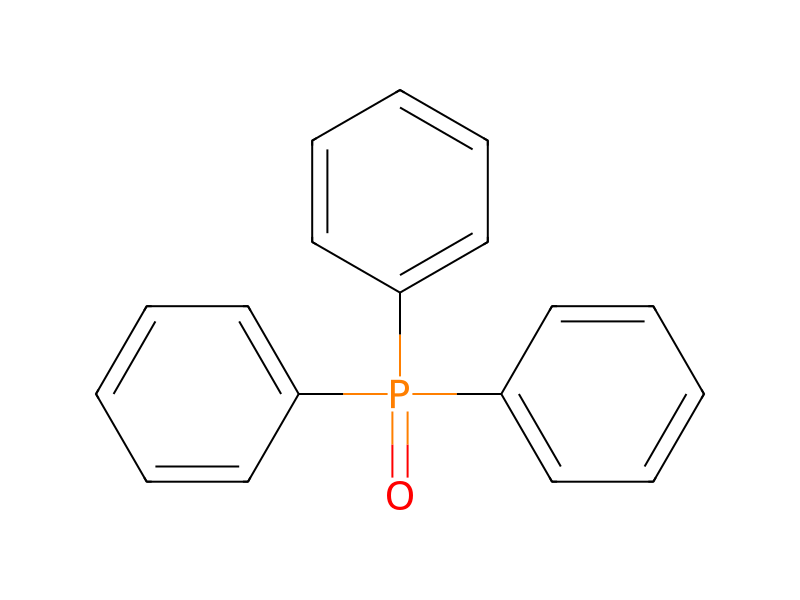
Triphenylphosphine Oxide → Triphenylphosphine
Reaction equation

[C:1]1([P:7](=O)([C:14]2[CH:19]=[CH:18][CH:17]=[CH:16][CH:15]=2)[C:8]2[CH:13]=[CH:12][CH:11]=[CH:10][CH:9]=2)[CH:6]=[CH:5][CH:4]=[CH:3][CH:2]=1.C1(P(=S)(C2C=CC=CC=2)C2C=CC=CC=2)C=CC=CC=1>>[C:14]1([P:7]([C:1]2[CH:2]=[CH:3][CH:4]=[CH:5][CH:6]=2)[C:8]2[CH:13]=[CH:12][CH:11]=[CH:10][CH:9]=2)[CH:15]=[CH:16][CH:17]=[CH:18][CH:19]=1Participants


Procedure
To an oven-dried 50-ml autoclave liner were added 16.68 g of triphenylphosphine oxide (.06 mole) and 0.057 g of sulfur (.0018 mole). The solids were treated with 11.12 g of silicon tetrachloride (.066 mole) and the mixture was placed in an autoclave which was then charged to a pressure of 715 p.s.i.g. (48 atm.) with hydrogen. The mixture was heated to 250°C for 15 hours at a maximum pressure of 77 atm. After cooling and venting, the reaction mixture was worked up by first partitioning between warm 30% by weight aqueous sodium hydroxide solution and toluene. The aqueous layer was extracted once with toluene and the combined organic layers were washed with water and with brine and dried over anhydrous sodium sulfate. Filtration and solvent removal gave 13.66 g (86.9%) of crude triphenylphosphine, mp 68°-77° which contained 2% triphenylphosphine oxide and 3% triphenylphosphine sulfide by gas-liquid chromatographic (glc) analysis. Recrystallization from methanol gave 11.25 g (71%) of purified triphenylphosphine, mp 75°-9°, still containing 1-2% triphenylphosphine sulfide by glc analysis.
Workup
- customRecrystallization from methanol
Sources & evidence
- ORD record
- ord-d00de6b219974a969edf13f0e80b6b97
- Source dataset
- uspto-grants-1977_02
- Patent number
- US04008282
Reaction notes
Loading…