Tetrahydrofuran → HCID 20316381, compound
Reaction equation

[Cl:1][C:2]1[CH:3]=[C:4]([CH:15]=[CH:16][C:17]=1[Cl:18])[CH2:5][NH:6][C:7](=[O:14])[C:8]([C:12]#[N:13])=[C:9]([CH3:11])[CH3:10].[CH3:19]OC(OC)N(C)C.O1CCCC1>C(O)C>[Cl:1][C:2]1[CH:3]=[C:4]([CH:15]=[CH:16][C:17]=1[Cl:18])[CH2:5][N:6]1[CH:19]=[CH:10][C:9]([CH3:11])=[C:8]([C:12]#[N:13])[C:7]1=[O:14]Participants
Reactant 3

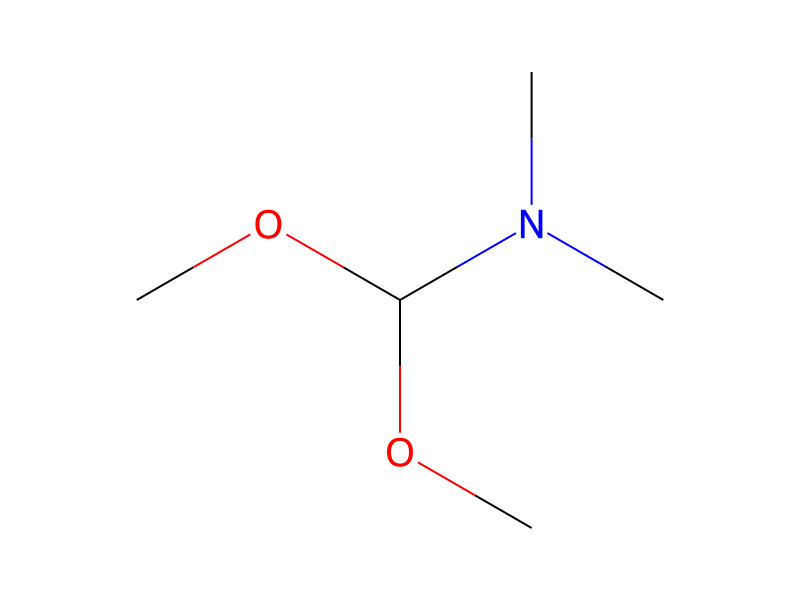

Product 1

Reagents, catalysts & solvents 1

Procedure
A solution of 42.8 g. (0.15 mole) of N-(3,4-dichlorobenzyl)-2-cyano-3-methylcrotonamide and 18.0 g. (0.15 mole) of N,N-dimethylformamide dimethyl acetal in 250 ml. of tetrahydrofuran is stirred at ambient temperature for 22 hr. followed by 1 hr. at reflux. The solvent is removed and the tacky solid residue is heated until molten. When evolution of dimethylamine subsides the reaction mixture is allowed to cool and the dark glassy residue is recrystallized from ethanol. The solid product is slurried in ether and isolated by filtration to give 15.79 g. (36%) of product as a brown powder: m.p. 177.5°-180.5° C.; ν (ethanol) 2210 (CN) and 1670 cm.-1 (C=O); δ 8.19 (d, 1H, H6), 7.2-7.8 (m, 3H, aromatic protons), 6.46 (d, 1H, H5), 5.16 (s, 2H, benzyl methylene), and 2.4 (s, 3H, methyl).
Workup
- temperatureat reflux
- customThe solvent is removed
- temperaturethe tacky solid residue is heated
- temperatureto cool
- customthe dark glassy residue is recrystallized from ethanol
- customisolated by filtration
- customto give 15.79 g
Sources & evidence
- ORD record
- ord-d4b822c3b10c4bd9a4ba9c13661905ce
- Source dataset
- uspto-grants-1977_06
- Patent number
- US04028084
Reaction notes
Loading…