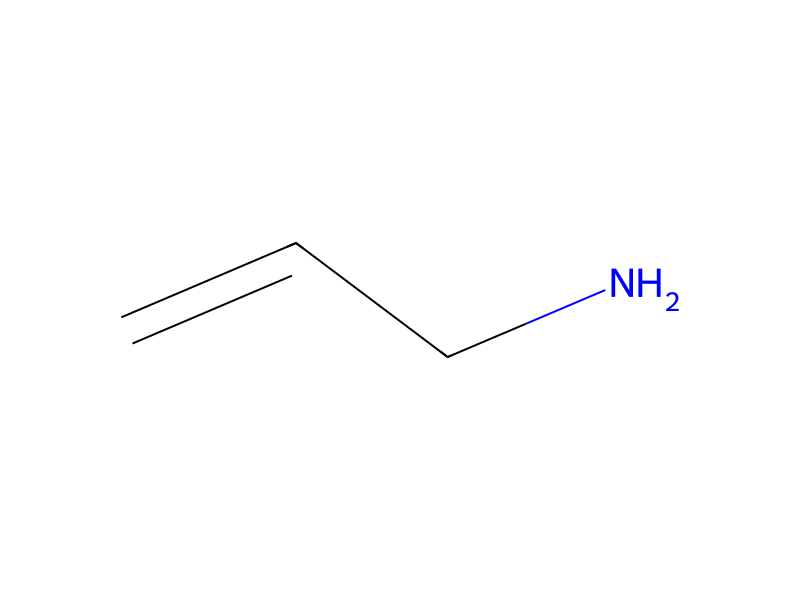
Allylamine → N-[1-(t-Butylazo)cyclohexyl]-N'-allylthiourea
Reaction equation

[C:1]([N:5]=[N:6][C:7]1([N:13]=[C:14]=[S:15])[CH2:12][CH2:11][CH2:10][CH2:9][CH2:8]1)([CH3:4])([CH3:3])[CH3:2].[CH2:16]([NH2:19])[CH:17]=[CH2:18]>CCCCC>[C:1]([N:5]=[N:6][C:7]1([NH:13][C:14]([NH:19][CH2:16][CH:17]=[CH2:18])=[S:15])[CH2:8][CH2:9][CH2:10][CH2:11][CH2:12]1)([CH3:4])([CH3:2])[CH3:3]Participants
4
Reactant 2

Product 1

Reagents, catalysts & solvents 1

Procedure
To 9.6 grams (.0416 moles) of 1-t-butylazo-1-isothiocyanatocyclohexane cooled to 10° C. and stirred with a magnetic stirrer in a 50 ml erlenmeyer flask was added 2.37 grams (.0416 moles) of allylamine. The reaction mixture became viscous, was diluted with pentane and stirred for 24 hours at room temperature. The pentane was stripped from the reaction mixture to leave an orange liquid weighing 11.3 grams (94% crude yield). The infrared spectrum of the product had a strong band at 1525 cm-1 and a sharp NH band at 3300 cm-1 and the isothiocyante band at 2040 cm-1 was very weak indicating a trace of the starting material was still present.
Workup
- stirringstirred for 24 hours at room temperature
- customto leave an orange liquid
Sources & evidence
- ORD record
- ord-f2597620455d4496b602af11f74b8b93
- Source dataset
- uspto-grants-1977_06
- Patent number
- US04028344
Reaction notes
Loading…