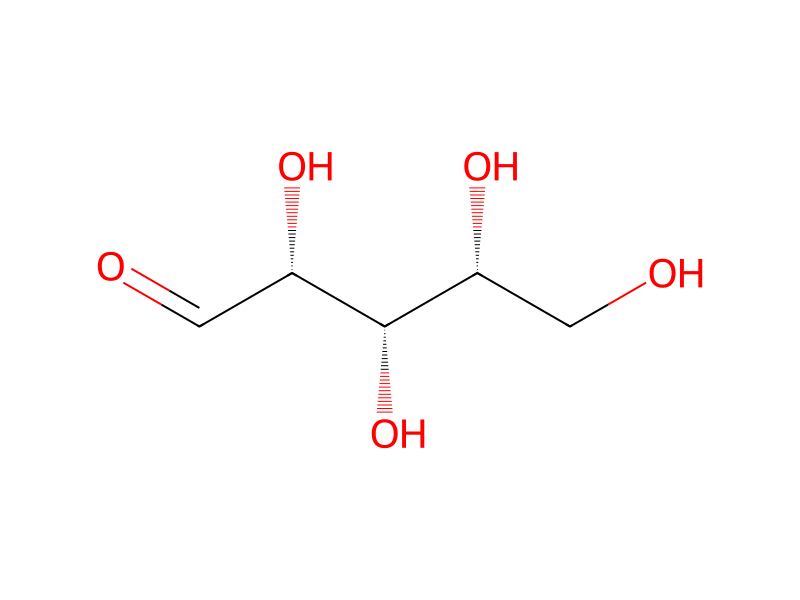
Ethanol → (2R,3S,4R,5R)-2,3,4,5,6-pentahydroxyhexanal
Reaction equation

[O:1]=[CH:2][C@@H:3]([C@H:5]([C@@H:7]([CH2:9][OH:10])[OH:8])[OH:6])[OH:4].[CH2:11]([OH:13])C>>[O:1]=[CH:2][C@@H:3]([C@H:5]([C@@H:7]([C@@H:9]([CH2:11][OH:13])[OH:10])[OH:8])[OH:6])[OH:4]Participants


Procedure
The results presented in FIG. 2 show that in contrast to the control strain containing the shuttle vector alone (CP4 pZB186!), the recombinant containing the added xylose isomerase, xylulokinase, transaldolase and transketolase genes demonstrated growth on and ethanol production from xylose as a carbon source. The recombinant strain produces ethanol from glucose as efficiently as the control strain at 94% of theoretical yield. The recombinant strain additionally produces ethanol from xylose at 84% of theoretical yield in 79 hours. Furthermore, in the combined presence of glucose and xylose, the recombinant strain ferments both sugars simultaneously to ethanol at 88% of theoretical yield within 48 hours, thus providing the foundation for advanced process designs with cofermentation of mixed-sugar feedstocks.
Workup
- additioncontaining the shuttle vector alone (CP4 pZB186!)
Sources & evidence
- ORD record
- ord-a3e1d7a1f10d4c329d0adbfdff4e9569
- Source dataset
- uspto-grants-1996_05
- Patent number
- US05514583
Reaction notes
Loading…