Water → 6,7-Dichloroquinoxaline-2,3-dione
Reaction equation

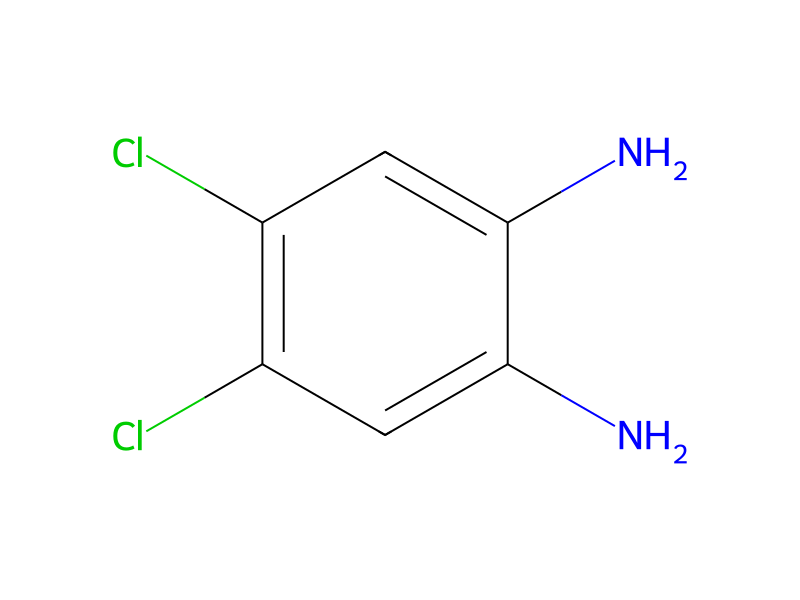
[CH:1]1[C:6]([Cl:7])=[C:5]([Cl:8])[CH:4]=[C:3]([NH2:9])[C:2]=1[NH2:10].O.O.[C:13](O)(=[O:17])[C:14](O)=[O:15].O>Cl>[Cl:7][C:6]1[C:5]([Cl:8])=[CH:4][C:3]2[C:2](=[N:10][C:13](=[O:17])[C:14](=[O:15])[N:9]=2)[CH:1]=1Participants
Reactant 3


Product 1

Reagents, catalysts & solvents 1

Conditions
- Temperature
- 125 °C
Procedure
A suspension of 2.655 g (15.0 mmol) of 4,5-dichlorophenylene-1,2-diamine and 1.986 g (15.75 nmol) oxalic acid dihydrate (Fisher Scientific Co., used as received) in 22.5 mL of 2N aq. HCl was refluxed with stirring at 125° C. (bath temperature) for 2.5 h, (during the first 5 min heating, the suspension almost turned into a solution, then began to form a precipitate). The reaction mixture was allowed to cool to 22° C., and H2O (50 mL) was added. The precipitate was collected on a Hirsh funnel by vacuum filtration, washed with H2O (6×25 mL) and dried at 60° C. under 0.1 mmHg for 12 h affording 3.39 g (98%) of 6,7-dichloroquinoxaline-2,3-dione as a deep pink powder. Mp. >400° C. 1H NMR (DMSO-d6): δ12.016 (s, 2H), 7.234 (s, 2H). This product was used in the next reaction without further purification.
Workup
- temperaturewas refluxed
- temperature(during the first 5 min heating
- customto form a precipitate)
- temperatureto cool to 22° C.
- filtrationThe precipitate was collected on a Hirsh funnel by vacuum filtration
- washwashed with H2O (6×25 mL)
- customdried at 60° C. under 0.1 mmHg for 12 h
Sources & evidence
- ORD record
- ord-84cff1e5cc5b4b5f86e41d3c04836675
- Source dataset
- uspto-grants-1996_05
- Patent number
- US05514680
Reaction notes
Loading…