Hydrochloric Acid → 1,2-Pyrrolidinedicarboxylic acid, 1-(1,1-dimethylethyl) ester, (2S)-
Reaction equation

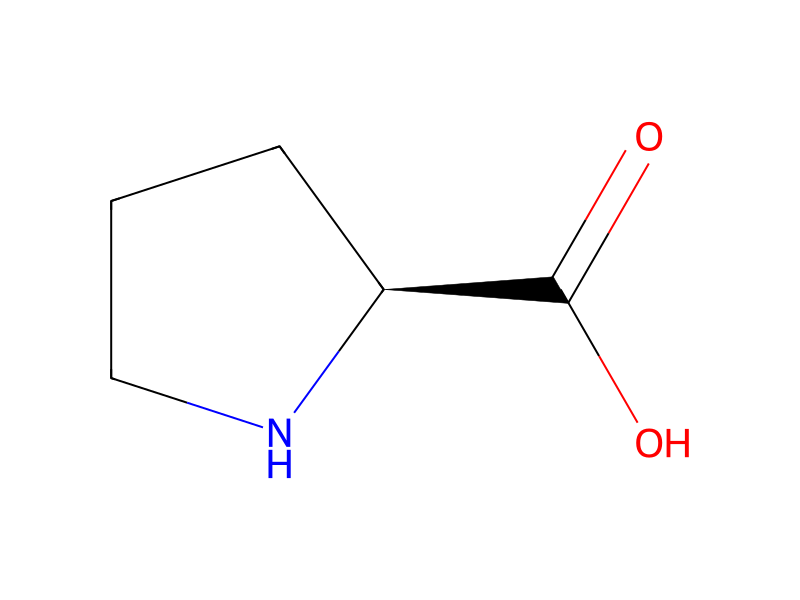
[NH:1]1[CH2:8][CH2:7][CH2:6][C@H:2]1[C:3]([OH:5])=[O:4].[Li].OC1C=CC=CN=1.[C:17](=O)([O-:34])[O:18][C:19]1([C:30](C)(C)C)[C:24](Cl)=C(Cl)C(Cl)=C(Cl)[CH:20]1Cl.Cl>[OH-].[Na+].O.C(Cl)(Cl)Cl.CN(C)C=O>[C:19]([O:18][C:17]([N:1]1[CH2:8][CH2:7][CH2:6][C@H:2]1[C:3]([OH:5])=[O:4])=[O:34])([CH3:30])([CH3:24])[CH3:20]Participants
10
Reactant 5



Product 1

Reagents, catalysts & solvents 4




Procedure
11.5 g. of L-proline is dissolved in 4N sodium hydroxide, and 100 ml. of dimethylformamide, 50 ml. of chloroform, 10.1 g. of the lithium salt of 2-hydroxypyridine and 36.6 g. of t-butylpentachlorophenyl carbonate are added thereto. The solution is stirred at room temperature for three hours, after which 100 ml. of chloroform and 200 ml. of water are added. After shaking, the water layer is acidified to a pH of 2 with 1N hydrochloric acid, and extracted with 200 ml. of ethyl acetate. The product is worked up as previously described to give t-butyloxycarbonyl-L-proline in 79 percent yield, m.p. 137° C.
Workup
- stirringAfter shaking
- extractionextracted with 200 ml
Sources & evidence
- ORD record
- ord-a70eafa4d8fa4b0fb82cd39fc24f505e
- Source dataset
- uspto-grants-1977_08
- Patent number
- USRE029369
Reaction notes
Loading…