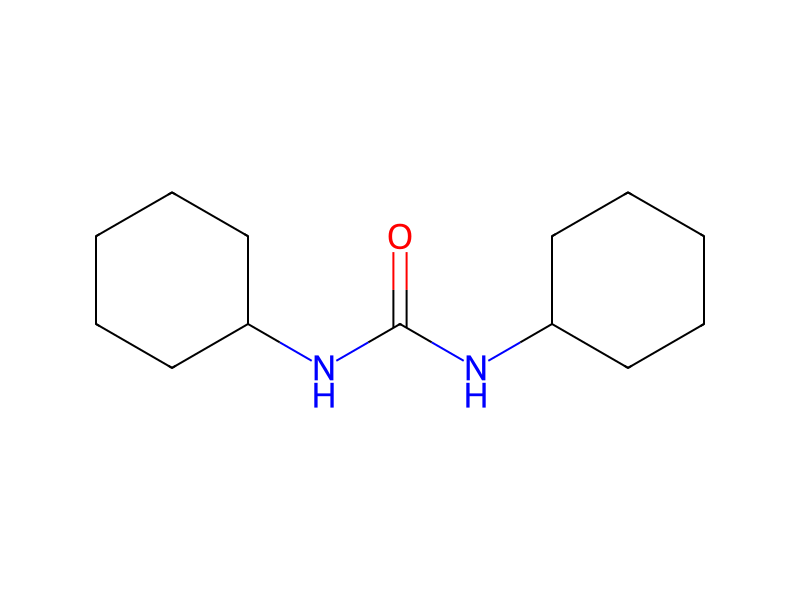
N-Phenyl-p-phenylenediamine → N,N'-Dicyclohexylurea
Reaction equation

C1C=CC(NC2C=CC(N)=CC=2)=CC=1.[OH:15]C1C2N=NNC=2C=CC=1.[CH:25]1([N:31]=[C:32]=[N:33][CH:34]2[CH2:39][CH2:38][CH2:37][CH2:36][CH2:35]2)[CH2:30][CH2:29][CH2:28][CH2:27][CH2:26]1>C1COCC1>[C:32]([NH:31][CH:25]1[CH2:26][CH2:27][CH2:28][CH2:29][CH2:30]1)([NH:33][CH:34]1[CH2:39][CH2:38][CH2:37][CH2:36][CH2:35]1)=[O:15]Participants
Reactant 3



Product 1
Reagents, catalysts & solvents 1

Procedure
1.65 g (8.98 mmol) of 4-aminodiphenylamine, 1.77 g (8.98 mmol) of intermediate 3.2 and 1.27 g (9.42 mmol) of hydroxybenzotriazole are dissolved in 40 ml of THF in a 100 ml flask, under a nitrogen atmosphere. When all have dissolved, 1.94 g (9.42 mmol) of 1,3-dicyclohexylcarbodiimide is added and the reaction medium is left under agitation for 15 hours. The precipitate of dicyclohexylurea formed is filtered and rinsed with ethyl acetate. The filtrate is evaporated under vacuum and the evaporation residue is taken up in ethyl acetate, it then forms a precipitate which is filtered and rinsed using the same solvent. A greenish solid is obtained with a yield of 65%. The product obtained is sufficiently pure to be used directly in the following stage. Melting point: 192–195° C.
Workup
- dissolutionWhen all have dissolved
Sources & evidence
- ORD record
- ord-89c9412d0bc94ee8b2f251f3d189ba21
- Source dataset
- uspto-grants-2007_03
- Patent number
- US07186752B2
Reaction notes
Loading…