Triphenylphosphine → HCID 58822921, compound
Reaction equation
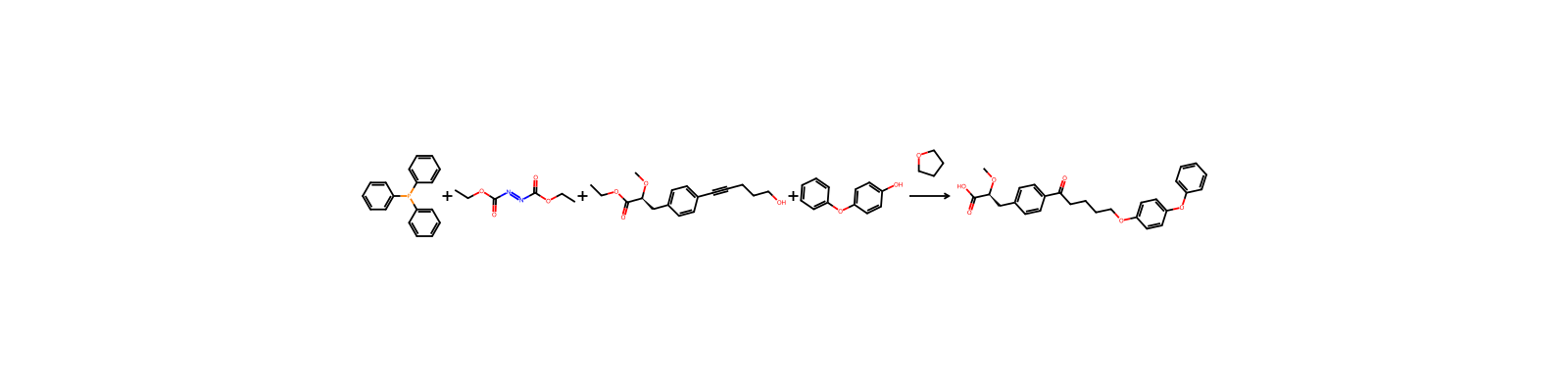
C1(P(C2C=CC=CC=2)C2C=CC=CC=2)C=CC=CC=1.CC[O:22]C(/N=N/C(OCC)=O)=O.C([O:34][C:35](=[O:52])[C@@H:36]([O:50][CH3:51])[CH2:37][C:38]1[CH:43]=[CH:42][C:41]([C:44]#[C:45][CH2:46][CH2:47][CH2:48][OH:49])=[CH:40][CH:39]=1)C.[O:53]([C:60]1[CH:65]=[CH:64][C:63](O)=[CH:62][CH:61]=1)[C:54]1[CH:59]=[CH:58][CH:57]=[CH:56][CH:55]=1>C1COCC1>[CH3:51][O:50][C@@H:36]([CH2:37][C:38]1[CH:39]=[CH:40][C:41]([C:44](=[O:22])[CH2:45][CH2:46][CH2:47][CH2:48][O:49][C:63]2[CH:62]=[CH:61][C:60]([O:53][C:54]3[CH:59]=[CH:58][CH:57]=[CH:56][CH:55]=3)=[CH:65][CH:64]=2)=[CH:42][CH:43]=1)[C:35]([OH:34])=[O:52]Participants
Reactant 4




Product 1

Reagents, catalysts & solvents 1

Procedure
A solution of triphenylphosphine (0.915 mmol) in 5 mL of dry THF was treated at 0° C. with diethylazodicarboxylate (0.915 mmol) and stirred for 20 min. A solution of (2S)-3-[4-(5-hydroxy-pent-1-ynyl)-phenyl]-2-methoxy-propionic acid ethyl ester (Example 21, Step A) (0.61 mmol) and 4-phenoxyphenol (0.915 mmol) in 2 mL of dry THF was added, and the mixture was stirred at room temperature overnight. The mixture was concentrated under vacuum and purified by silica gel chromatography (silica gel, hexanes/ethyl acetate 10:1 to 3:1). Fractions with Rfs 0.48 and 0.45 (hexanes/ethyl acetate 2:1) corresponding to the coupled compound and starting phenol, respectively, were combined and concentrated. The mixture was dissolved in 5 mL of methanol and was treated with a mire of 75 mg of mercury (II) oxide and 4% sulfuric acid in water. The solution was stirred at 55° C. for 3 hours, cooled to room temperature, diluted with saturated aqueous NaHCO3 (20 mL), and extracted with dichloromethane (4×20 mL). The combined organic layers were washed with brine (20 mL), dried (MgSO4), and concentrated. The residue was dissolved in 6 mL of methanol and 2 mL of 1N NaOH and stirred for 2 hours. The methanol was evaporated under vacuum, and the aqueous solution was diluted with brine (6 mL) and washed with diethyl ether (3×15 mL). The aqueous layer was acidified with 1N HCl (pH 1–2) and extracted with ethyl acetate (3×15 mL) then concentrated to give the title compound. 1H-NMR (CDCl3, 200.15 MHz): 7.91 (d, 2H, J=8.3), 7.36–7.27 (m, 4H), 7.07–6.83 (m, 7H), 4.08–3.96 (m, 3H), 3.41 (s, 3H), 3.22 (dd, 1H, J=14.0, 4.3), 3.14–3.01 (m, 4H), 1.26 (s, 1H).
Workup
- stirringthe mixture was stirred at room temperature overnight
- concentrationThe mixture was concentrated under vacuum
- custompurified by silica gel chromatography (silica gel, hexanes/ethyl acetate 10:1 to 3:1)
- concentrationconcentrated
- dissolutionThe mixture was dissolved in 5 mL of methanol
- additionwas treated with a mire of 75 mg of mercury (II) oxide and 4% sulfuric acid in water
- stirringThe solution was stirred at 55° C. for 3 hours
- additiondiluted with saturated aqueous NaHCO3 (20 mL)
- extractionextracted with dichloromethane (4×20 mL)
- washThe combined organic layers were washed with brine (20 mL)
- dry with materialdried (MgSO4)
- concentrationconcentrated
- dissolutionThe residue was dissolved in 6 mL of methanol
- stirring2 mL of 1N NaOH and stirred for 2 hours
- customThe methanol was evaporated under vacuum
- additionthe aqueous solution was diluted with brine (6 mL)
- washwashed with diethyl ether (3×15 mL)
- extractionextracted with ethyl acetate (3×15 mL)
- concentrationthen concentrated
Sources & evidence
- ORD record
- ord-5324f295e17f4fe0a2766345c054c599
- Source dataset
- uspto-grants-2007_03
- Patent number
- US07192982B2
Reaction notes
Loading…