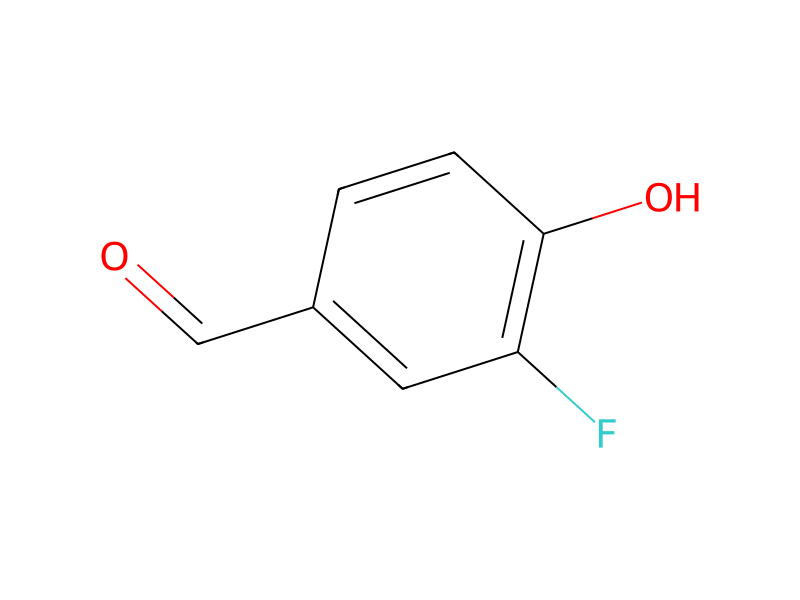
Hydrochloric Acid → 3-Fluoro-4-hydroxybenzaldehyde
Reaction equation

Cl.[O:2]1CCO[CH:3]1[C:7]1[CH:12]=[CH:11][C:10]([OH:13])=[C:9]([F:14])[CH:8]=1>C1COCC1.O>[F:14][C:9]1[CH:8]=[C:7]([CH:12]=[CH:11][C:10]=1[OH:13])[CH:3]=[O:2]Participants
5
Reactant 2


Product 1
Reagents, catalysts & solvents 2


Procedure
A solution of 1N HCl (1 mL) and 4-[1,3]dioxolan-2-yl-2-fluoro-phenol (250 mg, 1.35 mmol) in THF (2 mL) was stirred, at room temperature for 1 hour. The mixture was diluted with water and extracted with methylene chloride (4×10 mL). The combined organic layers were dried (Na2SO4), filtered and concentrated under vacuum. The residue was chromatographed (silica gel, hexanes/ethyl acetate 1:1) to produce 3-Fluoro-4-hydroxy-benzaldehyde as a white solid (180 mg, 95%). 1H-NMR (CDCl3, 200.15 MHz): 9.84 (d, 1H, J=2.4), 7.68–7.59 (m, 2H), 7.15 (t, 1H, J=8.5), 6.5 (sa, 1H).
Workup
- extractionextracted with methylene chloride (4×10 mL)
- dry with materialThe combined organic layers were dried (Na2SO4)
- filtrationfiltered
- concentrationconcentrated under vacuum
- customThe residue was chromatographed (silica gel, hexanes/ethyl acetate 1:1)
Sources & evidence
- ORD record
- ord-91e7f057624e4f06a19f010044a84fa2
- Source dataset
- uspto-grants-2007_03
- Patent number
- US07192982B2
Reaction notes
Loading…