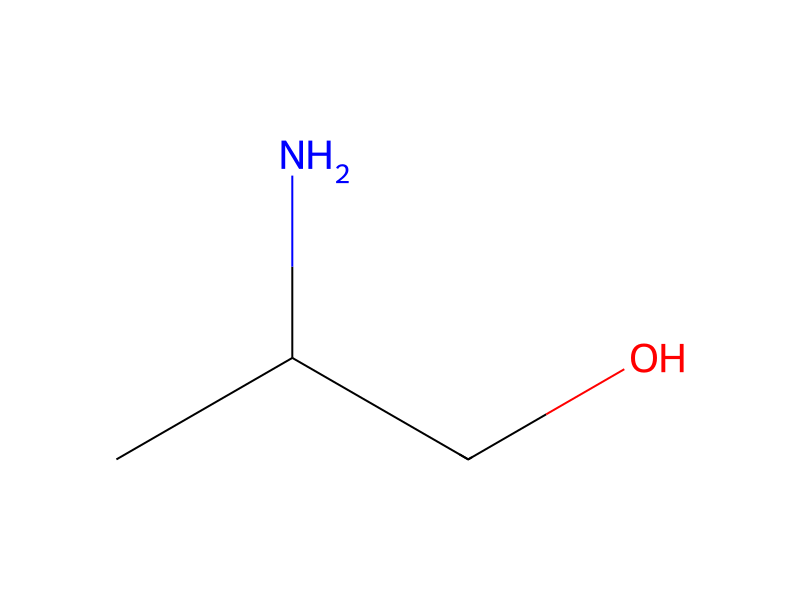
2-Aminopropanol → HCID 18771828, compound
Reaction equation

[Br:1][C:2]1[N:7]=[C:6]([CH:8]=O)[CH:5]=[CH:4][CH:3]=1.[CH3:10][CH:11]([NH2:14])[CH2:12][OH:13].[BH-](OC(C)=O)(OC(C)=O)OC(C)=O.[Na+].C([O-])(O)=O.[Na+]>C1(C)C=CC=CC=1.CC(O)=O>[Br:1][C:2]1[N:7]=[C:6]([CH2:8][NH:14][CH:11]([CH3:10])[CH2:12][OH:13])[CH:5]=[CH:4][CH:3]=1Participants






Procedure
To a stirred solution of the (6-bromo-2-pyridyl)-formaldehyde (0.52 g, 2.8 mmol) in toluene (14 mL) was added DL-2-amino-1-propanol (0.67 mL). The resulting mixture was heated to reflux with a Dean-Stark trap for 3 h under N2 until complete formation of the imine was observed. The mixture was brought to RT followed by the addition of a solution of NaBH(OAc)3 (2.0 g, 9.8 mmol) in AcOH (6 mL). The resulting mixture was stirred at RT and under N2 for 56 h. The mixture was neutralized (pH 7.0) with a saturated solution of NaHCO3 (aq) and extracted with CH2Cl2 (3×50 mL). The aqueous layer was concentrated by rotary evaporation and the residue obtained was extracted with CH2Cl2 (3×50 mL). The organic layers were combined, dried over MgSO4, filtered and concentrated by rotary evaporation to afford the title compound as a pale yellow oil. EI-MS m/z 245 (M+H).
Workup
- temperatureThe resulting mixture was heated
- customwas brought to RT
- extractionextracted with CH2Cl2 (3×50 mL)
- concentrationThe aqueous layer was concentrated by rotary evaporation
- customthe residue obtained
- extractionwas extracted with CH2Cl2 (3×50 mL)
- dry with materialdried over MgSO4
- filtrationfiltered
- concentrationconcentrated by rotary evaporation
Sources & evidence
- ORD record
- ord-f5946af98d364e5d894c6ae14f0986fa
- Source dataset
- uspto-grants-2007_03
- Patent number
- US07196104B2
Reaction notes
Loading…