3-Nitrobenzaldehyde → HCID 4379765, compound
Reaction equation

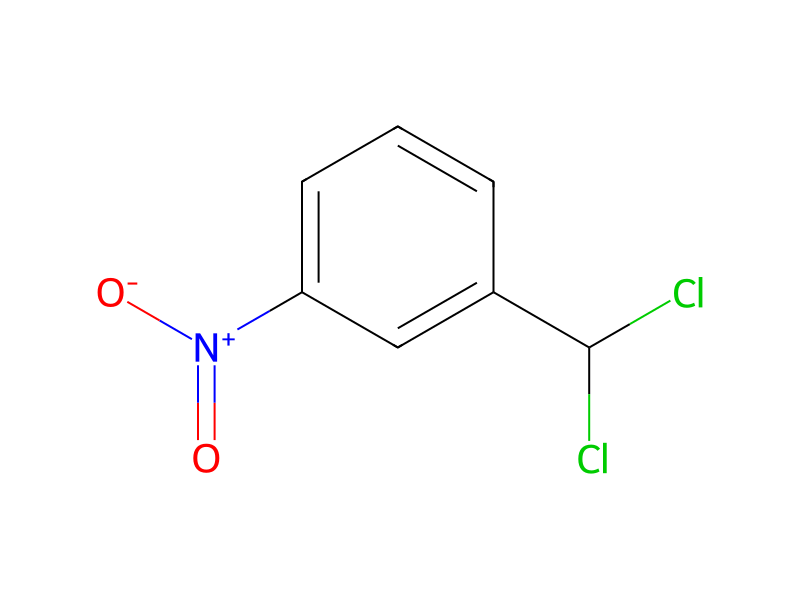
C1(P(C2C=CC=CC=2)C2C=CC=CC=2)C=CC=CC=1.[N+:20]([C:23]1[CH:24]=[C:25]([CH:28]=[CH:29][CH:30]=1)[CH:26]=O)([O-:22])=[O:21].[N+](C1C=C(C=CC=1)[CH:37]([Cl:39])[Cl:38])([O-])=O>C(Cl)(Cl)(Cl)Cl>[Cl:38][C:37]([Cl:39])=[CH:26][C:25]1[CH:28]=[CH:29][CH:30]=[C:23]([N+:20]([O-:22])=[O:21])[CH:24]=1Participants
Reactant 3


Product 1

Reagents, catalysts & solvents 1

Conditions
- Temperature
- 60 °C
Procedure
A solution of 32.8 g. of triphenylphosphine in 70 ml. of carbon tetrachloride is stirred for 3 hours at 60° C. to prepare in situ the reagent triphenylphosphine dichloromethylene. A solution of 18.9 g. of 3-nitro benzaldehyde in 60 ml. of carbon tetrachloride is added and the mixture is continued to be stirred at 60° C. for an additional 2 hours, when vapour phase chromatography indicates that all the starting 3-nitrobenzenealdehyde has disappeared and two new peaks in a ratio of 1:1 show the formation of a mixture of ββ-dichloro3-nitrostyrene and 3-nitrobenzalchloride. The reaction mixture is decanted from the solid residues and concentrated in vacuo to an oil. This is treated with ether, and again separated from some solid precipitate and the solution is again concentrated in vacuo. The oily residue is then carefully distilled in high vacuo to give essentially pure β,β-dichloro-3-nitrostyrene.
Workup
- customThe reaction mixture is decanted from the solid residues
- concentrationconcentrated in vacuo to an oil
- additionThis is treated with ether
- customagain separated from some solid precipitate
- concentrationthe solution is again concentrated in vacuo
- distillationThe oily residue is then carefully distilled in high vacuo
Sources & evidence
- ORD record
- ord-eb86ceffb52f485e91ff321d89a15fe3
- Source dataset
- uspto-grants-1977_12
- Patent number
- US04064239
Reaction notes
Loading…