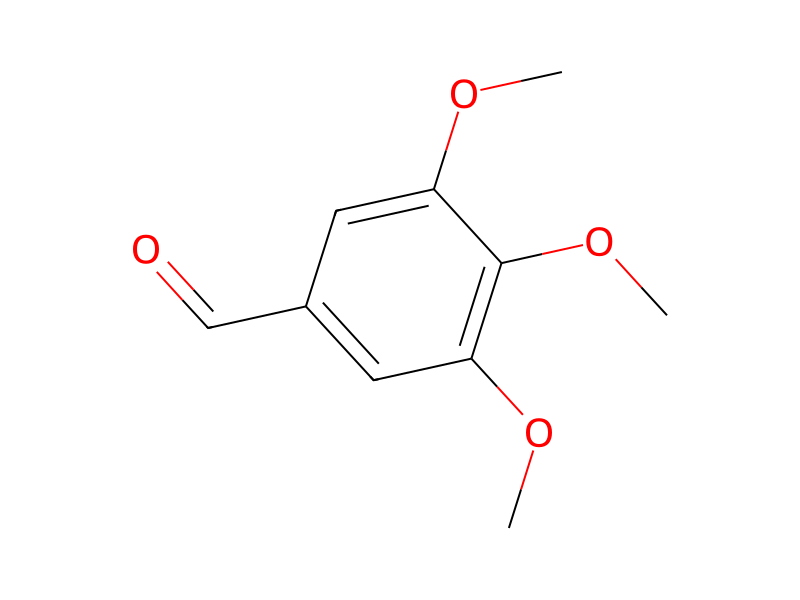
Carbon Dioxide → 3,4,5-Trimethoxybenzaldehyde
Reaction equation

[CH3:1][O:2][C:3]1[C:8]([OH:9])=[C:7]([O:10][CH3:11])[CH:6]=[C:5]([CH:12]=[O:13])[CH:4]=1.S(OC)(O[CH3:18])(=O)=O.C(=O)([O-])[O-].[K+].[K+].C(=O)=O>C1C=CC=CC=1.O>[CH3:11][O:10][C:7]1[CH:6]=[C:5]([CH:4]=[C:3]([O:2][CH3:1])[C:8]=1[O:9][CH3:18])[CH:12]=[O:13]Participants
7
Reactant 4




Product 1
Reagents, catalysts & solvents 2


Conditions
- Temperature
- 75 °C
Procedure
25.0g syringealdehyde (0.137 mol), 26.6g of dimethyl sulfate (0.211 mol), and 27.7 g. of potassium carbonate (0.201 mol) were heated with stirring as in Example 1. When the temperature reached 45° C the mixture became fluid and carbon dioxide was given off. The temperature was slowly increased to 75° C and held at this value for 1 hour. Addition of water, acidification, and benzene extraction gave a quantitative yield of 3,4,5-trimethoxybenzaldehyde which contained no detectable syringealdehyde or other impurities as determined by g.l.c. analysis.
Workup
- customreached 45° C
Sources & evidence
- ORD record
- ord-48f7050fef5c45bfa15562d00b0b701b
- Source dataset
- uspto-grants-1977_12
- Patent number
- US04065504
Reaction notes
Loading…