Dichloromethane → HCID 13457850, compound
Reaction equation
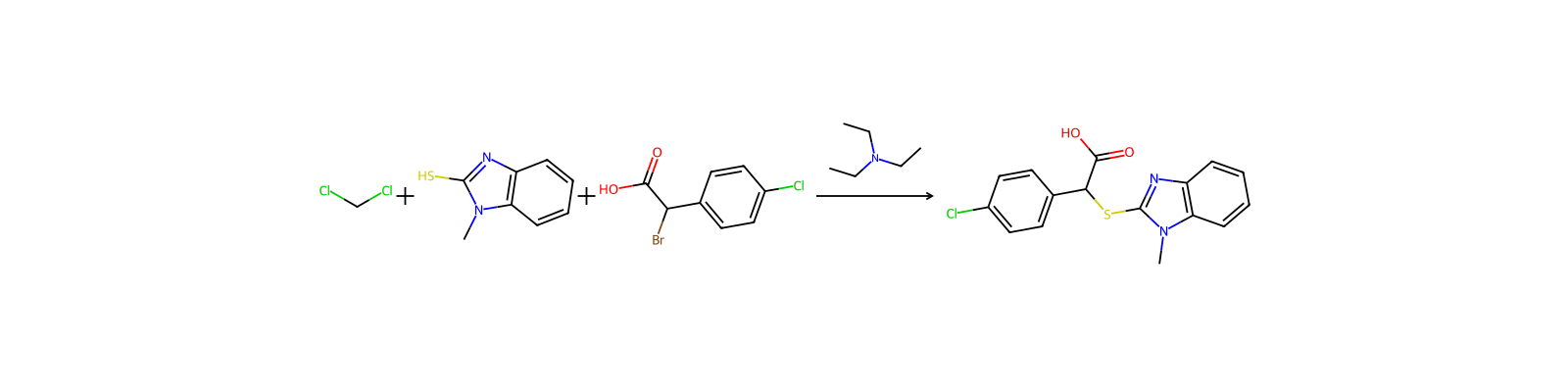
C(Cl)Cl.[SH:4][C:5]1[N:9]([CH3:10])[C:8]2[CH:11]=[CH:12][CH:13]=[CH:14][C:7]=2[N:6]=1.Br[CH:16]([C:20]1[CH:25]=[CH:24][C:23]([Cl:26])=[CH:22][CH:21]=1)[C:17]([OH:19])=[O:18]>C(N(CC)CC)C>[Cl:26][C:23]1[CH:22]=[CH:21][C:20]([CH:16]([S:4][C:5]2[N:9]([CH3:10])[C:8]3[CH:11]=[CH:12][CH:13]=[CH:14][C:7]=3[N:6]=2)[C:17]([OH:19])=[O:18])=[CH:25][CH:24]=1Participants
5
Reactant 3



Product 1

Reagents, catalysts & solvents 1

Procedure
A methylene chloride solution of 3.3 g (0.02M) of 2-mercapto-1-methyl-1H-benzimidazole, 5.0 g (0.02M) of α-bromo-(p-chlorophenyl)acetic acid and 4.0 g (0.04M) of triethylamine is heated to reflux overnight. The reaction mixture is neutralized with a diluted HCL solution. The layers are separated and the organic layer is dried over anhydrous magnesium sulfate. After removal of methylene chloride the residue is recrystallized from acetonitrile. The recrystallized material weighs 4.1 g (41% yield) and has a melting point of 161°-3° C. dec.
Workup
- temperatureto reflux overnight
- customThe layers are separated
- dry with materialthe organic layer is dried over anhydrous magnesium sulfate
- customAfter removal of methylene chloride the residue
- customis recrystallized from acetonitrile
Sources & evidence
- ORD record
- ord-d0ca4776a20d40edbe0eb7f5c3e47d45
- Source dataset
- uspto-grants-1985_05
- Patent number
- US04520196
Reaction notes
Loading…