Triethylamine → HCID 13556902, compound
Reaction equation

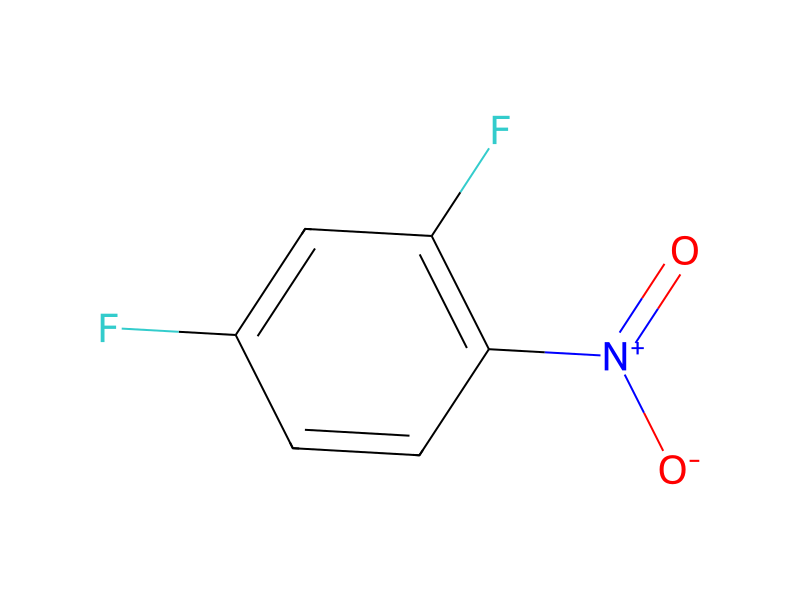
[CH2:1]=[CH:2][CH2:3][SH:4].F[C:6]1[CH:11]=[C:10]([F:12])[CH:9]=[CH:8][C:7]=1[N+:13]([O-:15])=[O:14].C(N(CC)CC)C>O1CCCC1>[CH2:3]([S:4][C:6]1[CH:11]=[C:10]([F:12])[CH:9]=[CH:8][C:7]=1[N+:13]([O-:15])=[O:14])[CH:2]=[CH2:1]Participants
Reactant 3


Product 1

Reagents, catalysts & solvents 1

Procedure
A solution of 2.3 g (0.031 mole) of allylthiol in 25 ml of tetrahydrofuran was added to 5.0 g (0.031 mole) of 2,4-difluoronitrobenzene in 25 ml of tetrahydrofuran at -30° C. To this mixture was added dropwise 3.1 g (0.031 mole) of triethylamine. The temperature was allowed to rise to room temperature and stirring was continued for four hours. The tetrahydrofuran was evaporated under reduced pressure, and water and diethyl ether were added to the residue. The ether layer was separated and dried over anhydrous potassium carbonate. The ether was evaporated under reduced pressure, leaving a liquid residue. This residue was distilled at 105° C./1.2 mm of Hg, yielding 4.2 g of 2-allylthio-4-fluoronitrobenzene. The nmr spectrum was consistent with the proposed structure.
Workup
- customto rise to room temperature
- customThe tetrahydrofuran was evaporated under reduced pressure, and water and diethyl ether
- additionwere added to the residue
- customThe ether layer was separated
- dry with materialdried over anhydrous potassium carbonate
- customThe ether was evaporated under reduced pressure
- customleaving a liquid residue
- distillationThis residue was distilled at 105° C./1.2 mm of Hg
Sources & evidence
- ORD record
- ord-7d52994e3a0c4223ab5ad34b2c4316af
- Source dataset
- uspto-grants-1985_10
- Patent number
- US04548640
Reaction notes
Loading…