Triethylamine → HCID 20262080, compound
Reaction equation

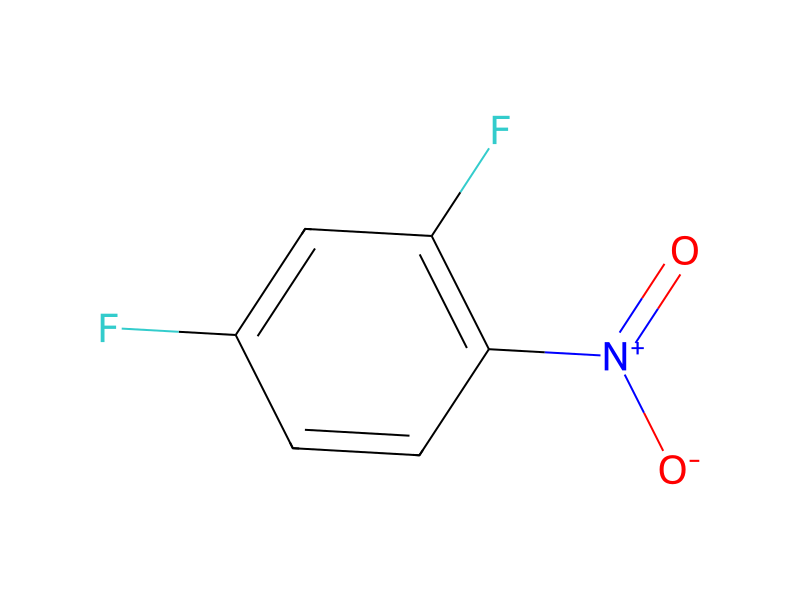
F[C:2]1[CH:7]=[C:6]([F:8])[CH:5]=[CH:4][C:3]=1[N+:9]([O-:11])=[O:10].[CH3:12][C:13](=[CH2:16])[CH2:14][SH:15].C(N(CC)CC)C>O1CCCC1>[CH3:16][C:13](=[CH2:12])[CH2:14][S:15][C:2]1[CH:7]=[C:6]([F:8])[CH:5]=[CH:4][C:3]=1[N+:9]([O-:11])=[O:10]Participants
Reactant 3


Product 1

Reagents, catalysts & solvents 1

Procedure
To a solution of 5.0 g (0.031 mole) of 2,4-difluoronitrobenzene and 2.8 g (0.031 mole) of 2-methyl-2-propenethiol in 25 ml of tetrahydrofuran at room temperature was added dropwise 3.1 g (0.031 mole) of triethylamine. The reaction mixture was stirred at room temperature for forty-eight hours and then at 50° C. for eight hours. The tetrahydrofuran was removed under reduced pressure, and water was mixed with the residue. This aqueous mixture was extracted with chloroform. The chloroform extract was washed with water, dried, and the chloroform evaporated under reduced pressure, leaving an oily residue. Distillation of this residue under reduced pressure yielded 6.0 g of 2-(2-methyl-2-propenylthio)-4-fluoronitrobenzene. The nmr spectrum was consistent with the proposed structure.
Workup
- customThe tetrahydrofuran was removed under reduced pressure, and water
- additionwas mixed with the residue
- extractionThis aqueous mixture was extracted with chloroform
- extractionThe chloroform extract
- washwas washed with water
- customdried
- customthe chloroform evaporated under reduced pressure
- customleaving an oily residue
- distillationDistillation of this residue under reduced pressure
Sources & evidence
- ORD record
- ord-b717fa2e502249e48bdfc2b1afd2558c
- Source dataset
- uspto-grants-1985_10
- Patent number
- US04548640
Reaction notes
Loading…