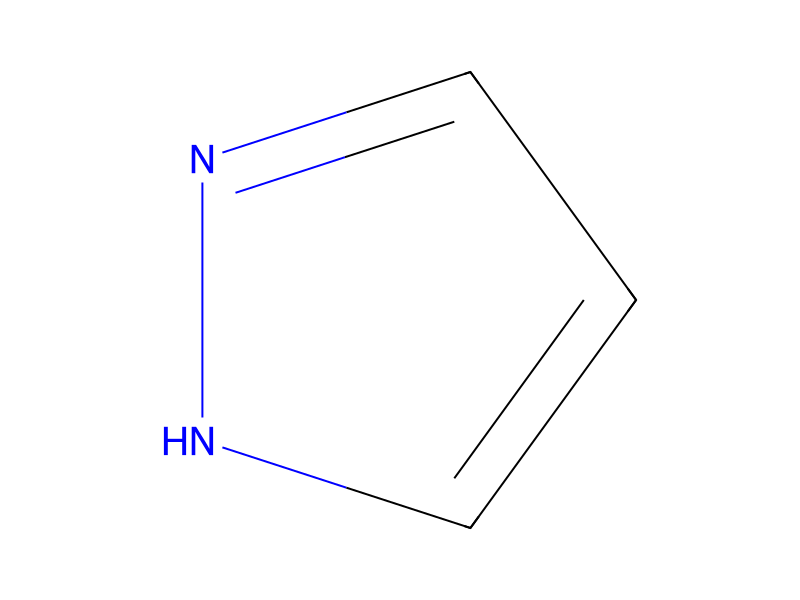
Hydrazine hydrate (1:1) → Pyrazole
Reaction equation

CC1C=CC([N:8]2C3C(C(C)C)=[C:14]([OH:17])[CH:15]=CC=3C([N+]([O-])=O)=[C:9]2/[CH:24]=[CH:25]/[N:26](C)C)=CC=1.[NH:29]([C:31]1[N:36]([CH3:37])[C:35](=[O:38])[N:34]([CH3:39])[C:33](=[O:40])[CH:32]=1)[NH2:30].[OH2:41].NN>>[NH:29]([C:31]1[N:36]([CH3:37])[C:35](=[O:38])[N:34]([CH3:39])[C:33](=[O:40])[CH:32]=1)[NH2:30].[C:33]([O:40][C:14](=[O:17])[CH3:15])(=[O:41])[CH3:32].[NH:26]1[CH:25]=[CH:24][CH:9]=[N:8]1Participants




Procedure
An approach for the synthesis of compounds of the general formula (Id-1) where R1, R2, U and V are as defined herein above is depicted in Scheme 8. The synthesis starts from known 6-hydrazino-1,3-dimethyluracil (30) which is readily prepared by the displacement of halogen of 6-chloro-1,3-dialkyuracil of the formula (20) with hydrazine hydrate according to the known procedure. The cyclisation of compound of the formula (30) with acetic anhydride gave pyrazole of the formula (31). The deacetylation followed by selective N-alkylation of pyrazole (31) with dimethyl sulfate afforded compounds of the formula (33) (Pfleiderer, W. et al., Justus Liebigs Ann Chem. 1958, 615, 42-47). The reaction of compound of formula (33) with dimethyl carbonate in presence of a strong base (e.g. NaH) under reflux conditions gives ester of the formula (34). Hydrolysis of ester (34) with aqueous acid afforded the desired pyrazolo[3,4-d]pyrimidinedione acetic acid of the formula (35). The coupling of compound of formula (35) with respective amines of formula (18) by using a standard amide coupling method gives compounds of general formula (Id-1).
Sources & evidence
- ORD record
- ord-bf2a795f2f034eb584bdebed15511571
- Source dataset
- uspto-grants-2014_01
- Patent number
- US08623880B2
Reaction notes
Loading…