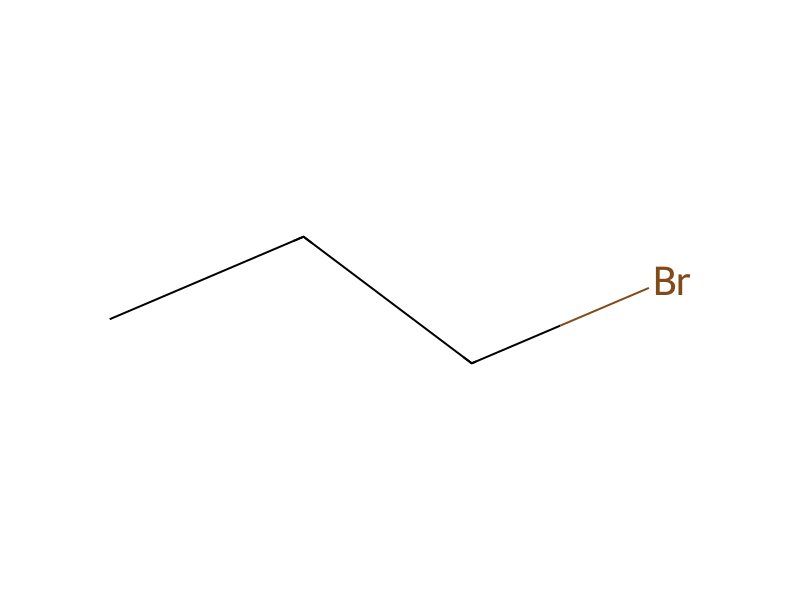
1-Bromopropane → HCID 23135147, compound
Reaction equation

[CH2:1]([N:8]1[C:12]2[CH2:13][CH:14]([OH:16])[CH2:15][C:11]=2[C:10]([C:17]#[N:18])=[N:9]1)[C:2]1[CH:7]=[CH:6][CH:5]=[CH:4][CH:3]=1.[H-].[Na+].[CH2:21](Br)[CH2:22][CH3:23]>CN(C=O)C>[CH2:1]([N:8]1[C:12]2[CH2:13][CH:14]([O:16][CH2:21][CH2:22][CH3:23])[CH2:15][C:11]=2[C:10]([C:17]#[N:18])=[N:9]1)[C:2]1[CH:3]=[CH:4][CH:5]=[CH:6][CH:7]=1Participants
Reactant 3


Product 1

Reagents, catalysts & solvents 1

Procedure
To a solution of 1-benzyl-5-hydroxy-1,4,5,6-tetrahydrocyclo-penta[c]pyrazole-3-carbonitrile-(see Example 9.7, 30 mg, 0.125 mmol) in anhydrous DMF (2 mL) was added sodium hydride (6 mg, 0.15 mmol, 60% dispersion in oil). After stirring for 3 minutes propyl bromide was added (14 μL, 0.15 mmol) and the resulting mixture stirred for an hour. At the end of this time sodium hydride (6 mg, 0.15 mmol, 60% dispersion in oil) and propyl bromide were added. After 30 minutes the reaction was quenched by adding saturated NH4Cl (3 mL). The resulting mixture was extracted with ethyl acetate, washed with brine, dried over anhydrous Na2SO4, filtered and concentrated in vacuo. The residue was purified by PTLC (SiO2) using 15% ethyl acetate-hexanes to give the desired product.
Workup
- additionwas added (14 μL, 0.15 mmol)
- customAfter 30 minutes the reaction was quenched
- additionby adding saturated NH4Cl (3 mL)
- extractionThe resulting mixture was extracted with ethyl acetate
- washwashed with brine
- dry with materialdried over anhydrous Na2SO4
- filtrationfiltered
- concentrationconcentrated in vacuo
- customThe residue was purified by PTLC (SiO2)
Sources & evidence
- ORD record
- ord-b0167e9b8d71404b8c680b40fc9b32ce
- Source dataset
- uspto-grants-2014_01
- Patent number
- US08637555B2
Reaction notes
Loading…