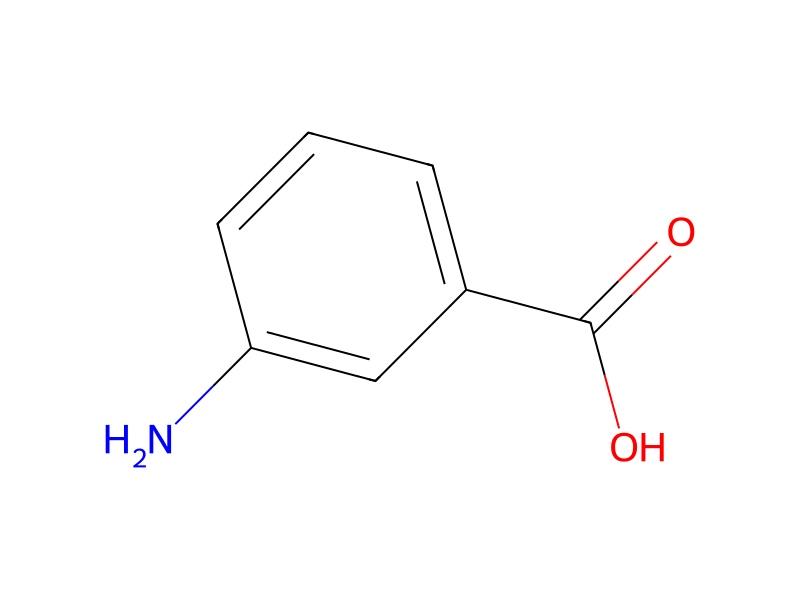
3-Aminobenzoic Acid → 4-Anilino-5-bromo-2-(3-carboxyanilino)pyrimidine
Reaction equation

[NH:1]([C:8]1[C:13]([Br:14])=[CH:12][N:11]=[C:10](Cl)[N:9]=1)[C:2]1[CH:7]=[CH:6][CH:5]=[CH:4][CH:3]=1.[NH2:16][C:17]1[CH:18]=[C:19]([CH:23]=[CH:24][CH:25]=1)[C:20]([OH:22])=[O:21]>>[NH:1]([C:8]1[C:13]([Br:14])=[CH:12][N:11]=[C:10]([NH:16][C:17]2[CH:25]=[CH:24][CH:23]=[C:19]([C:20]([OH:22])=[O:21])[CH:18]=2)[N:9]=1)[C:2]1[CH:7]=[CH:6][CH:5]=[CH:4][CH:3]=1Participants
3


Procedure
Using an analogous method to that described in Method 1, but starting from 4-anilino-5-bromo-2-chloropyrimidine and 3-aminobenzoic acid, the product was obtained. NMR: 7.2-7.4 (m, 4H), 7.55-7.6 (m, 3H), 7.8 (dd, 1H), 7.95 (s, 1H), 8.4 (s, 1H), 9.3 (br s, 1H), 10.2 (br s 1H); MS (MH+): 385, 387.
Workup
- customthe product was obtained
Sources & evidence
- ORD record
- ord-de4b2118f3ce4bea94c85482f633f8ad
- Source dataset
- uspto-grants-2003_11
- Patent number
- US06649608B2
Reaction notes
Loading…