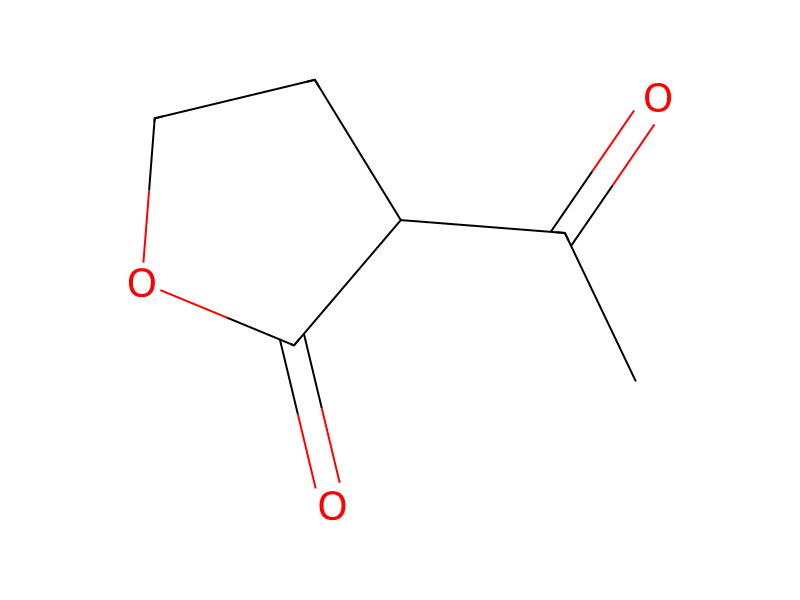
2-Acetylbutyrolactone → 3-(4-Methylphenyl)-6-(2-chloroethyl)-7-methyl-thiazolo[3,2-a]pyrimidin-5-one
Reaction equation

[NH2:1][C:2]1[S:3][CH:4]=[C:5]([C:7]2[CH:12]=[CH:11][C:10]([CH3:13])=[CH:9][CH:8]=2)[N:6]=1.P(Cl)(Cl)([Cl:16])=O.[C:19]([CH:22]1[CH2:27][CH2:26]O[C:23]1=[O:24])(=O)[CH3:20].[OH-].[Na+]>>[CH3:13][C:10]1[CH:11]=[CH:12][C:7]([C:5]2[N:6]3[C:23](=[O:24])[C:22]([CH2:27][CH2:26][Cl:16])=[C:19]([CH3:20])[N:1]=[C:2]3[S:3][CH:4]=2)=[CH:8][CH:9]=1Participants




Procedure
5.7 g (30 mmoles) of 2-amino-4-(4-methylphenyl)-thiazol were dissolved in 11 ml (120 mmoles) of phosphorus oxychloride. To the solution formed, 3.25 ml (30 mmoles) of 2-acetyl-butyrolactone were slowly added. The mixture was refluxed for 2 hours, allowed to cool and poured onto 100 g of ice, then basified to pH 9 by adding sodium hydroxide and extracted twice with 100 ml of methylene chloride each time. The organic phase was washed twice with 50 ml of water each time and dried, and the solvent was removed by reduced pressure distillation. The residue formed was purified on a silica gel column using methylene chloride as eluent. 3.4 g of 3-(4-methylphenyl)-6-(2-chloroethyl)-7-methyl-thiazolo[3,2-a]pyrimidin-5-one were obtained as a yellowish solid, mp 152°-165° C.
Workup
- customTo the solution formed
- temperatureThe mixture was refluxed for 2 hours
- temperatureto cool
- extractionextracted twice with 100 ml of methylene chloride each time
- washThe organic phase was washed twice with 50 ml of water each time
- customdried
- customthe solvent was removed by reduced pressure distillation
- customThe residue formed
- customwas purified on a silica gel column
Sources & evidence
- ORD record
- ord-3c7312f957e24ce19de870b2ab6c6c02
- Source dataset
- uspto-grants-1998_08
- Patent number
- US05798361
Reaction notes
Loading…