Toluene → 3-(4-Ethenylphenyl)-2-propenenitrile
Reaction equation

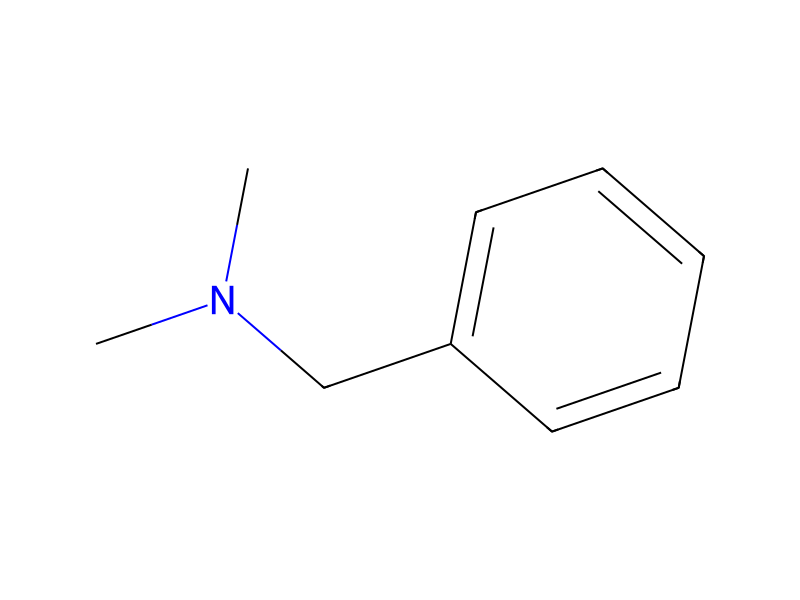
Cl[C:2]([C:4]1[CH:13]=[CH:12][C:7]([CH:8]=[CH:9][C:10]#[N:11])=[CH:6][CH:5]=1)=O.[CH2:14](N(C)C)C1C=CC=CC=1.C1(C)C=CC=CC=1>C([O-])(=O)C.[Pd+2].C([O-])(=O)C.CCCCC>[CH:2]([C:4]1[CH:13]=[CH:12][C:7]([CH:8]=[CH:9][C:10]#[N:11])=[CH:6][CH:5]=1)=[CH2:14]Participants
Reactant 3


Product 1

Reagents, catalysts & solvents 2


Conditions
- Temperature
- 140 °C
Procedure
2.39 g (12.5 mmols) of 4-chloroformylcinnamonitrile, 1.69 g (12.5 mmols) of N-benzyldimethylamine and 0.0280 g (0.125 mmol) of palladium acetate are added under argon to 25 ml of toluene. The reaction mixture is stirred for 4 hours at 140° C. under an ethylene pressure of 10 bar. The mixture is then extracted by shaking at room temperature with 100 ml of 2N HCl and 100 ml of 2N NaOH and is dried over magnesium sulfate. The solution is then evaporated and the residue is chromatographed over silica gel using methylene dichloride as the migrating agent. The yellow oil thus obtained is dissolved in boiling n-pentane. 0.84 g (44% of theory) of 4-vinylcinnamonitrile are formed at -20° C. in the form of white crystals; melting point 45.8° C.
Workup
- extractionThe mixture is then extracted
- stirringby shaking at room temperature with 100 ml of 2N HCl and 100 ml of 2N NaOH
- dry with materialis dried over magnesium sulfate
- customThe solution is then evaporated
- customthe residue is chromatographed over silica gel
- customThe yellow oil thus obtained
- dissolutionis dissolved
Sources & evidence
- ORD record
- ord-9ec2c50a9216457cbbeb6b05ae117d0b
- Source dataset
- uspto-grants-1985_08
- Patent number
- US04533505
Reaction notes
Loading…