Phenol → Resorcinol
Reaktionsgleichung

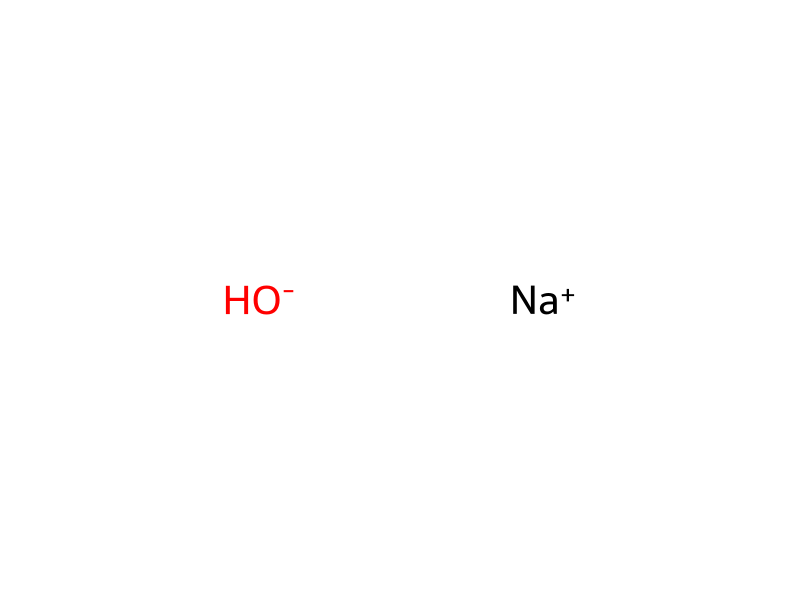
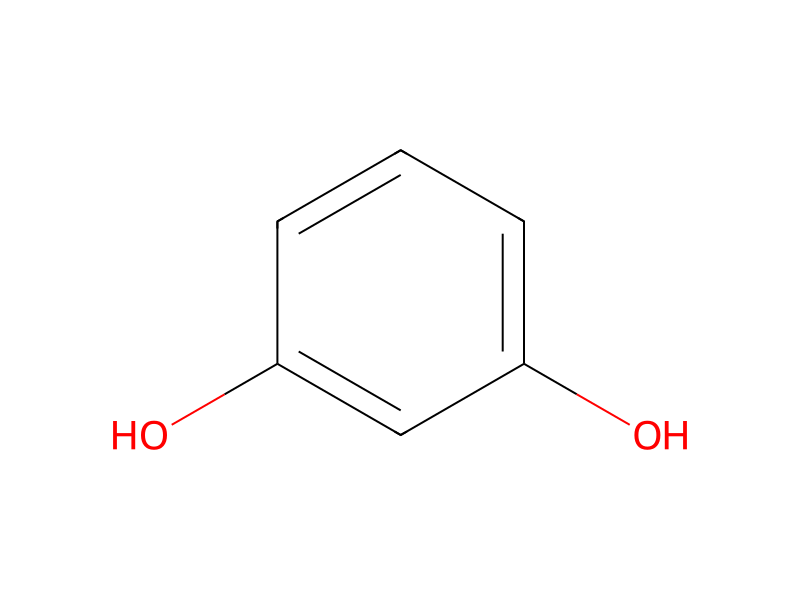
[OH-:1].[Na+].[C:3]1([OH:9])[CH:8]=[CH:7][CH:6]=[CH:5][CH:4]=1.[Na]>O.[N+]([O-])([O-])=O.[Ni+2].[N+]([O-])([O-])=O.[Pt]>[C:3]1([CH:8]=[CH:7][CH:6]=[C:5]([OH:1])[CH:4]=1)[OH:9].[C:3]1([OH:1])[CH:8]=[CH:7][CH:6]=[C:5]([C:5]2[CH:4]=[C:3]([OH:9])[CH:8]=[CH:7][CH:6]=2)[CH:4]=1.[C:3]1([OH:1])[C:4]([C:5]2[CH:4]=[C:3]([OH:9])[CH:8]=[CH:7][CH:6]=2)=[CH:5][CH:6]=[CH:7][CH:8]=1Komponenten





Reaktionsbedingungen
- Temperatur
- 395 °C
Versuchsvorschrift
A mixture of five parts by weight of sodium hydroxide and one part by weight of phenol dissolved in a minimum amount of water was stirred together until all of the phenol had been converted to its sodium salt. Then a solution of nickel (II) nitrate was added, the quantity of nickel ion being 0.01 mole per mole of phenol. This mixture was heated under vacuum (about 1 mm Hg) in a platinum crucible at about 150°-200° C. until all of the water was removed and then heated to 395° C. for two hours while still under vacuum. Shortly before the melting point of the mixture was reached, the green color of the nickel turned black indicating that the nickel had been reduced to nickel metal or converted to a black oxide. As soon as the mixture melted, evolution of gas began and continued during the entire heating period. After cooling to room temperature, the mixture was dissolved in water, and the solution was adjusted to pH 7 with sulfuric acid. After thorough extraction with ether, the pH of the solution was lowered to 2, and another extraction with ether was conducted. The ether extracts were dried and then evaporated to dryness. The residue of the extract at pH 7 weighed 1.20 times the weight of the phenol charged while the pH 2 residue weighed 0.05 times the weight of phenol charged. Thin layer chromotograms (TLC) of the pH 7 residue showed that 40% of the phenol charged remained and that resorcinol, 3,3'-biphenol (3,3'-dihydroxybiphenyl), and 2,3'-biphenol in 2.5%, 3.5% and about 1% yields respectively were obtained. The biphenols were identified by comparison of their Rf values and their infrared spectra with authentic samples. A trace of 2,2'-biphenol, identified by its Rf, was also formed. When this experiment is conducted without the nickel catalyst, some gas evolution is observed but much less than that with the nickel, and only traces of the products mentioned are formed.
Aufarbeitung
- customwas removed
- temperatureentire heating period
- temperatureAfter cooling to room temperature
- dissolutionthe mixture was dissolved in water
- extractionAfter thorough extraction with ether
- extractionanother extraction with ether
- dry with materialThe ether extracts were dried
- customevaporated to dryness
- extractionThe residue of the extract at pH 7
- additioncharged while the pH 2 residue
- additioncharged
- additioncharged
Quellen und Nachweise
- ORD-Eintrag
- ord-bdeff6749bfe40008d357d9507da6ba3
- Quelldatensatz
- uspto-grants-1985_08
- Patentnummer
- US04533765
Notizen zur Reaktion
Wird geladen…