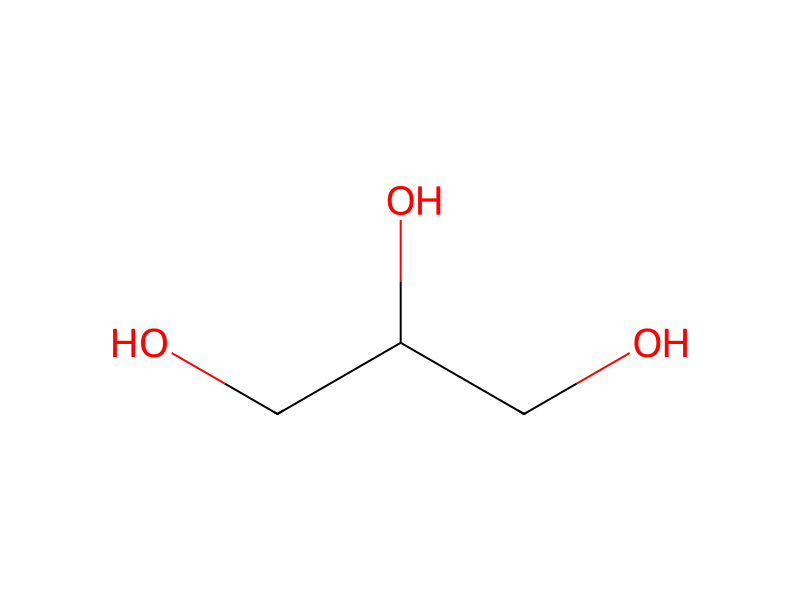
Glycerol → 1709-72-4
Reaction equation

[OH:1][CH2:2][CH:3]([CH2:5][OH:6])[OH:4].[O:7]1[CH2:12][CH2:11]OCC1.[C:13](Cl)(=[O:16])[CH:14]=[CH2:15].O.[C:19](OCC)(=O)C>C(N(CC)CC)C>[C:13]([O:1][CH2:2][CH:3]([CH2:5][O:6][C:12](=[O:7])[CH:11]=[CH2:19])[OH:4])(=[O:16])[CH:14]=[CH2:15]Participants
Reactant 5




Product 1

Reagents, catalysts & solvents 1

Conditions
- Temperature
- 50 °C
Procedure
4.6 g of glycerine was dissolved in 50 g of ethyl acetate, to which several drops of triethylamine was added while agitating. Thereafter, a 1,4-dioxane solution of 10 g of acrylic chloride was dropped into the solution, followed by agitating at room temperature for further 2 hours and further agitating for 1 hour after raising the temperature up to 50° C. The reaction solution was discharged and admixed with water, followed by shaking, removing water-soluble components from the system and distilling off the 1,4-dioxane to obtain glycerol-1,3-diacrylate. 10 g (0.05 mole) of the glycerol-1,3-diacrylate, 20.2 g (0.03 mole) of a partially esterified product of styrene/maleic anhydride copolymer ("Styrite CM-2L", molecular weight≈5000, product of Sankyo Kasei Co., Ltd.), 20 mg of hydroquinone were dissolved in 85 g of 1,4-dioxane and agitated at 90° C for 4 hours, followed by dropping the reaction solution into 3 liters of water and drying the resulting precipitate in vacuo, thereby obtaining a carboxylic acid semi-ester polymer (polyfunctional resin).
Workup
- additionwas added
- stirringby agitating at room temperature for further 2 hours
- stirringfurther agitating for 1 hour
- stirringby shaking
- customremoving water-soluble components from the system
- distillationdistilling off the 1,4-dioxane
Sources & evidence
- ORD record
- ord-2cdfa0499c0740d5b7deba37688f5acb
- Source dataset
- uspto-grants-1985_08
- Patent number
- US04537855
Reaction notes
Loading…